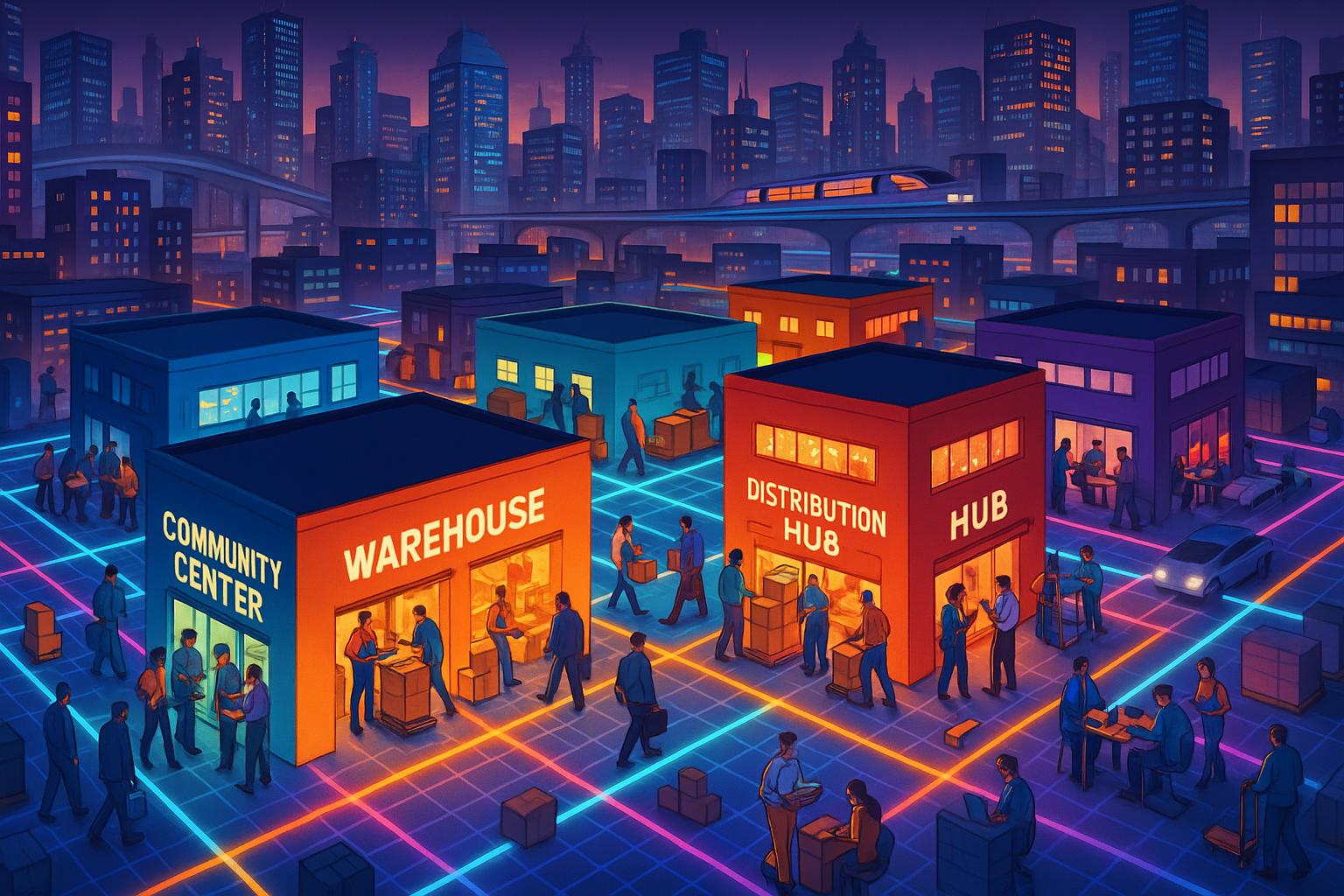
Most corporate supply chains remain stitched together with bespoke point-to‑point links, batch EDI flows and partner portals that rarely extend beyond direct suppliers. The result is a landscape where documents move but collective decision‑making does not, leaving networks ill prepared for the recurrent shocks of demand swings, regulation, sustainability pressures and geopolitical disruption. The constraint, increasingly, is not the quantity of data but the absence of shared meaning and co‑ordinated action across independent organisations.
In practice, that fragmentation shows up when ports congest, key suppliers miss deliveries or new compliance obligations arrive. Organisations typically react with email threads, spreadsheets and a tangle of dashboards that define “risk,” “late” or “short” differently for each participant. Early adopters have experimented with artificial intelligence inside individual planning or visibility programmes, but those pilots rarely change how entire communities respond together.
Closing that gap requires a shift from point integration to multi‑enterprise orchestration. Industry thinking points to five practical moves that can turn disparate partners into a functioning community.
Establish common data semantics. Partners must agree definitions for business events such as at‑risk orders, in‑transit delays, capacity shortfalls and payment mismatches, and represent them with consistent data structures. When signals carry the same meaning across organisations, AI can learn useful patterns instead of noise.
Codify community playbooks. Repeatable, cross‑party response plans , specifying triggers, roles, service levels, required data and automatable steps , provide a blueprint for workflow engines and agentic AI to recommend and, where appropriate, execute joint actions.
Push lightweight, agentic AI to the edge. Small, context‑aware agents located near orders, shipments, inventory and invoices can surface emerging patterns in real time and propose remedial measures that span companies, from alternate fulfilment sources to freight rebooking or dynamic ATP adjustments.
Bake in rights‑based data sharing. Visibility without governance undermines trust. Role‑and policy‑driven access controls let each party see only what it needs while enabling AI to reason over a permissioned, aggregated view consistent with privacy and cross‑border rules.
Track time‑to‑joint‑action. Conventional KPIs end at enterprise boundaries. A community metric that measures how quickly a set of trading partners can detect, decide and act on a shared event converts orchestration from aspiration into operational practice.
Adoption will not be frictionless. Data lineage and provenance remain major obstacles: without traceable origins and transformation histories, model outputs struggle to gain traction with practitioners. Organisational change is equally demanding; technology roll‑outs can be fast, but aligning incentives, contracts and processes across multiple companies requires sustained executive sponsorship. Governance frameworks must walk a tightrope between enabling openness and enforcing control, while respecting regional data sovereignty and compliance obligations.
Looking ahead, proponents expect a two‑stage evolution. In the near term, through roughly 2026–2028, leading networks will move away from reactive exception handling toward anticipatory orchestration. AI will not supplant human judgment but will pre‑analyse alternatives, quantify trade‑offs across cost, service and emissions, and coordinate proposed responses with affected partners. Real‑time community dashboards will surface early warnings such as accumulating delays, abnormal lead‑time variance or supplier stress, allowing remediation before disputes and deductions escalate.
Beyond 2029, supply links are likely to cohere into digital communities governed by shared norms, transparent incentives and a collective memory that improves responses over time. Procurement, logistics and finance functions may converge around common outcomes , resilience, service and sustainability , rather than isolated transactions. Competitive advantage will accrue to ecosystems that can sense disruption and act together.
Commercial platforms are positioning themselves to enable this transition. According to OpenText, its Business Network is designed to support large‑scale multi‑enterprise collaboration by linking suppliers, customers, logistics providers and financial institutions with standardised processes and shared data semantics. The vendor says the network normalises transactions into common business objects and events, creating the semantic bedrock necessary for cross‑partner orchestration and AI.
OpenText also presents a layered view of capability: proven connectivity across EDI, APIs and cloud architectures to onboard and manage thousands of partners; community‑level workflow orchestration for processes such as purchase‑to‑pay, order‑to‑cash and logistics execution; and AI that operates over permissioned, multi‑party data to detect risks, prioritise exceptions and recommend actions. The company emphasises identity‑driven governance, role‑based visibility and auditability as the trust mechanisms that make broad collaboration feasible under strict regulatory and data‑sovereignty regimes.
Other OpenText materials frame Supply Chain Orchestration as the next logical stage beyond traditional supply chain management, with a Trading Grid that acts as a secure conduit for integrating partners and turning fragmented information into an AI‑ready platform. Their automation roadmap stresses that removing manual, paper‑based processes and standardising B2B exchanges reduces human error, accelerates transactions and frees staff for strategic work , necessary preconditions for higher‑order orchestration.
The technical and organisational challenges are real, but so are the potential payoffs. By aligning semantics, automating shared playbooks, deploying edge AI agents, enforcing governed data sharing and measuring community reaction time, firms can move from isolated efficiency to collective agility. Vendors such as OpenText position their cloud networks and integration stacks as the infrastructure to support that journey, though the ultimate determinant will be whether trading communities can reform incentives and governance as well as technology.
As volatility, regulation and stakeholder expectations continue to intensify, the firms that succeed will be those that treat supply chains as communities rather than chained systems , creating the conditions for partners to sense, decide and act in concert.
Source: Noah Wire Services