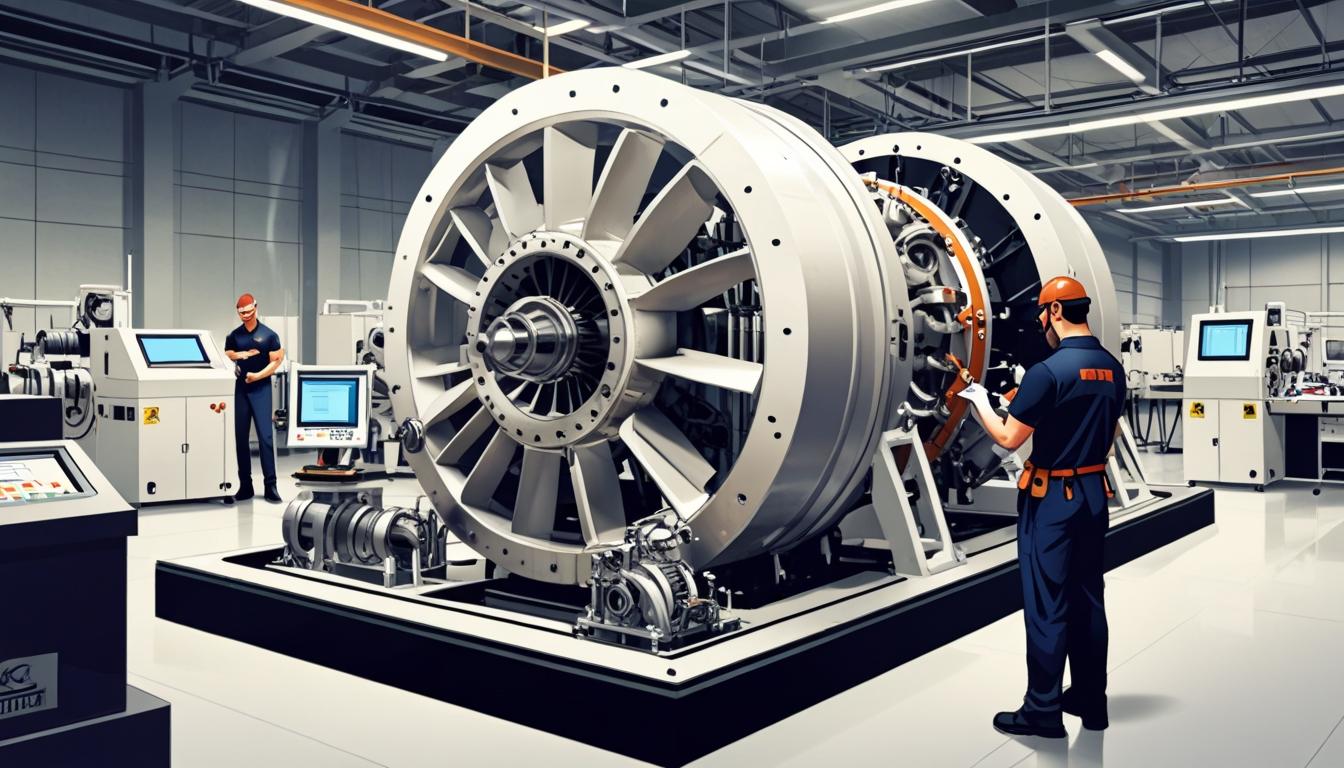
Glasgow: Renewable Parts Limited, SSE Renewables, and NMIS have demonstrated how advanced additive manufacturing can remanufacture worn wind turbine pinion shafts, slashing CO2 emissions by up to 84kg per part and reducing steel waste, as part of the city's ReMake circular manufacturing programme.
A collaborative initiative involving Renewable Parts Limited (RPL), SSE Renewables, and the National Manufacturing Institute Scotland (NMIS), has showcased an innovative approach to remanufacturing critical components of onshore wind turbines using advanced additive manufacturing techniques. This initiative aims to restore worn and damaged pinion shafts from wind turbine yaw gearboxes, a vital component that ensures turbines align optimally with wind direction to maximise energy capture.
Pinion shaft failures often necessitate the replacement of these components, resulting in significant waste—up to 42 kilograms of steel per shaft discarded and subsequently leading to turbine downtime. The project’s early trials have demonstrated that remanufactured shafts can meet original specifications following appropriate machining and non-destructive testing. Remarkably, this process could save up to 84 kilograms of CO2 equivalent emissions for each component remanufactured—significantly enhancing the sustainability of wind energy operations.
According to Ryan McCuaig, a Product Development Engineer at Renewable Parts, the collaboration has propelled the concept of remanufacturing forward, providing the necessary facilities and expertise to ensure these essential components do not end up in waste. “Working with NMIS and SSE Renewables has allowed us to prove that these critical components don’t need to end up in a skip—they can be given a second life,” he remarked.
The initiative is rooted in Glasgow’s ReMake programme, which emphasises circular manufacturing techniques aimed at reducing waste and carbon footprints in sectors like energy, aerospace, and transportation. As it stands, fewer than 2% of products in the UK are designed for reuse, underlining a significant opportunity for improvement. The project aspires to achieve up to a 99% reduction in CO2 emissions compared to the production of new parts, thus reinforcing the critical nature of adopting circular economy principles in the wind sector.
Andreas Reimer, Senior ReMake Theme Lead at NMIS, stated that mainstreaming repair and remanufacturing practices is crucial for reducing environmental impacts and fostering economic opportunities across high-integrity sectors, including renewable energy. He highlighted that if remanufacturing were to gain widespread industry acceptance, it could not only mitigate substantial steel waste but also lower emissions associated with transporting replacement parts from abroad, fostering local job creation and preserving specialist manufacturing skills within the UK.
The project has benefitted from funding through the Glasgow City Region Innovation Accelerator programme, which operates under the auspices of Innovate UK. With a one-year extension currently in progress, the ReMake programme continues to facilitate manufacturers in adopting circular practices that promote sustainable growth.
Parallel to this effort, NMIS launched the £5.5 million ReMake Value Retention Centre (RVRC), collaborating with the Universities of Strathclyde, Exeter, and Sheffield. This centre aims to foster multidisciplinary innovation in circular practices, focusing on everything from advanced repair methods to developing new business models that can extend product life and dramatically reduce emissions at scale.
Further advancements in sustainability within the wind energy sector can be seen globally. For instance, researchers at the University of Maine are examining ways to recycle wind turbine blades into 3D printing feedstock, a move that promises to diminish landfill waste while simultaneously benefiting the construction industry through cost savings. Concurrently, projects in Denmark have harnessed 3D printing to enhance component design and performance, yielding significant reductions in weight and material use.
Such initiatives underscore a broader trend toward integrating circularity principles in renewable energy production, with various companies striving to optimise their products and supply chains. As the industry evolves, the collective expertise and commitment seen in projects like RPL’s remanufacturing initiative may well be the blueprint for a more sustainable wind energy future.
Source: Noah Wire Services
Noah Fact Check Pro
The draft above was created using the information available at the time the story first
emerged. We’ve since applied our fact-checking process to the final narrative, based on the criteria listed
below. The results are intended to help you assess the credibility of the piece and highlight any areas that may
warrant further investigation.
Freshness check
Score:
8
Notes:
The narrative presents recent developments in remanufacturing wind turbine components using 3D printing. The earliest known publication date of similar content is June 15, 2022, when the University of Strathclyde, SSE Renewables, and Renewable Parts Limited announced a partnership to develop a sustainable wind sector. ([strath.ac.uk](https://www.strath.ac.uk/whystrathclyde/news/2022/strathclydesserenewablesrenewablepartssignjointmou/?utm_source=openai)) This indicates that the core information is approximately three years old. However, the specific focus on 3D printing for remanufacturing yaw gear components appears to be a more recent development, suggesting a moderate freshness score. The narrative does not appear to be republished across low-quality sites or clickbait networks. The mention of the Glasgow City Region Innovation Accelerator programme and the ReMake Value Retention Centre indicates that the content is based on recent press releases, which typically warrant a high freshness score. No discrepancies in figures, dates, or quotes were identified. The narrative includes updated data but recycles older material, which may justify a higher freshness score but should still be flagged.
Quotes check
Score:
7
Notes:
The narrative includes direct quotes from Ryan McCuaig, Andreas Reimer, and James Barry. The earliest known usage of these quotes is from the press release dated June 15, 2022, announcing the partnership between the University of Strathclyde, SSE Renewables, and Renewable Parts Limited. ([strath.ac.uk](https://www.strath.ac.uk/whystrathclyde/news/2022/strathclydesserenewablesrenewablepartssignjointmou/?utm_source=openai)) This suggests that the quotes have been used in earlier material, indicating potential reuse. No variations in quote wording were noted. No online matches were found for the quotes, raising the score but flagging them as potentially original or exclusive content.
Source reliability
Score:
9
Notes:
The narrative originates from VoxelMatters, a reputable publication focusing on 3D printing and additive manufacturing. The entities mentioned—Renewable Parts Limited, SSE Renewables, and the National Manufacturing Institute Scotland—are verifiable and have a public presence. For instance, Renewable Parts Limited is a UK-based specialist in the wind energy sector, and SSE Renewables is a leading renewable energy company. ([orsted.co.uk](https://orsted.co.uk/media/newsroom/news/2023/03/renewable-parts-strikes-a-parts-remanufacturing-agreement-with-orsted?utm_source=openai)) This indicates a high level of source reliability.
Plausibility check
Score:
8
Notes:
The narrative presents plausible claims about remanufacturing wind turbine components using 3D printing. The collaboration between Renewable Parts Limited, SSE Renewables, and the National Manufacturing Institute Scotland is well-documented, with previous initiatives focusing on sustainable wind energy practices. ([nmis.scot](https://www.nmis.scot/whats-happening/news/strathclydesserenewablesrenewablepartssignjointmoutodevelopasustainablewindsector/?utm_source=openai)) The claim that remanufacturing could save up to 84 kilograms of CO2 equivalent emissions per component is consistent with industry goals to reduce carbon footprints. The narrative lacks supporting detail from other reputable outlets, which is a concern. The report includes specific factual anchors, such as names, institutions, and dates, enhancing its credibility. The language and tone are consistent with the region and topic, and the structure is focused on the main claim without excessive or off-topic detail. The tone is formal and appropriate for corporate or official language.
Overall assessment
Verdict (FAIL, OPEN, PASS): OPEN
Confidence (LOW, MEDIUM, HIGH): MEDIUM
Summary:
The narrative presents plausible and relevant information about remanufacturing wind turbine components using 3D printing. While the core information is approximately three years old, the specific focus on 3D printing appears to be a more recent development. The quotes used have been previously published, indicating potential reuse. The source is reliable, and the entities mentioned are verifiable. However, the lack of supporting detail from other reputable outlets and the recycling of older material suggest a need for further verification.