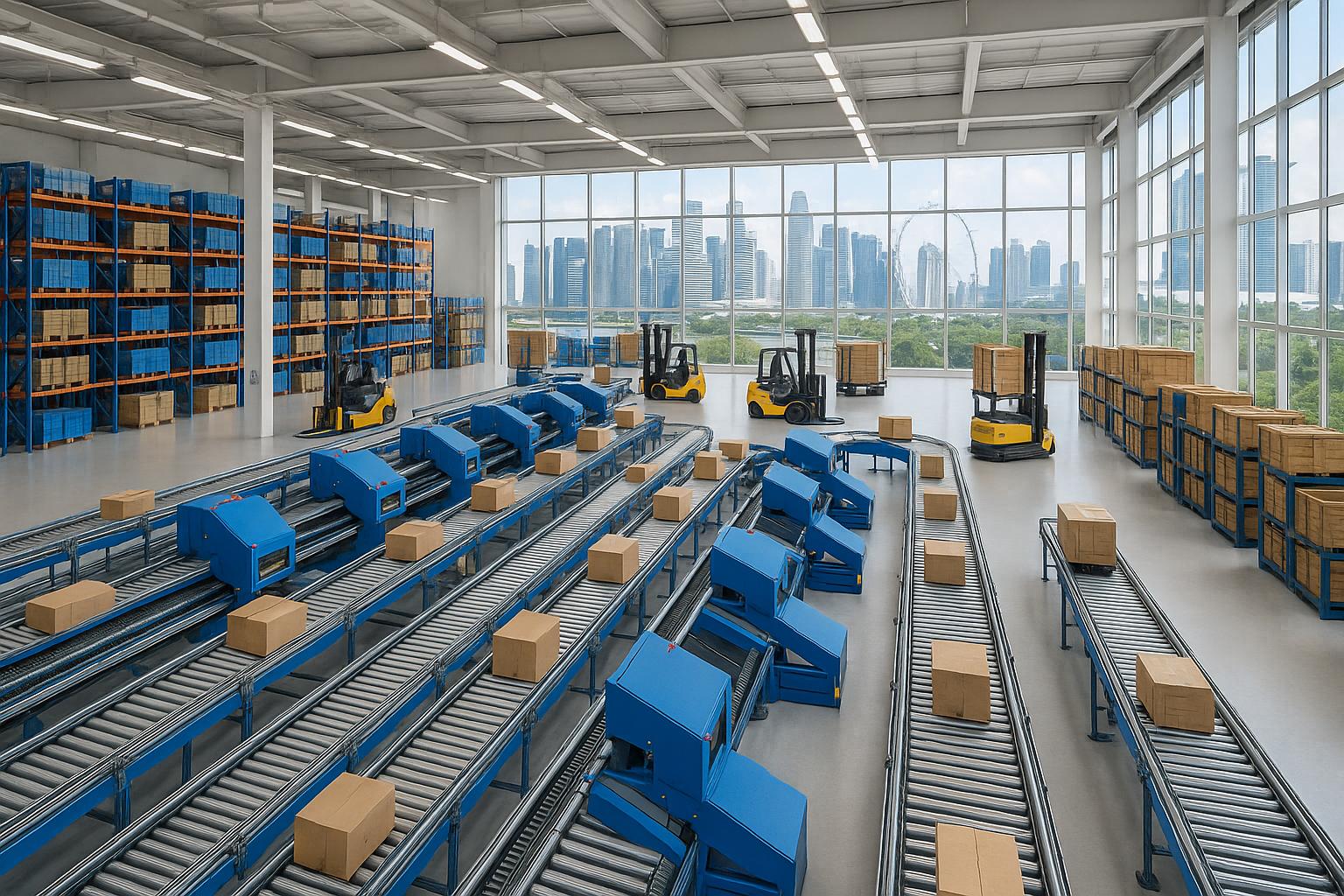
Maersk has officially opened World Gateway II, a fully automated regional distribution centre in Singapore that the company says will sharpen its e-commerce and contract‑logistics offering across Asia-Pacific.
According to The Straits Times, the S$200 million facility, unveiled on March 18, occupies about 1.1 million square feet close to the new Tuas Port and nearly doubles Maersk’s logistics footprint in Singapore to roughly 2.2 million square feet. Maersk expects the site to create around 500 roles across operations, engineering and supply‑chain functions once it reaches full operation. The company noted the centre is already about 70 per cent committed. The Straits Times also reported that the hub will be customs bonded, allowing customers to defer or avoid goods and services tax on goods held in storage until they enter the local market.
Vincent Clerc, chief executive of A.P. Moller‑Maersk, told guests at the opening that consumer demand for everyday goods remains resilient despite geopolitical disruption. “Despite the noise out there, people are still sending their children off to school with a new backpack. And when the new Formula One season begins, many will find a good excuse to upgrade their TVs,” he said. Clerc framed World Gateway II as part of Maersk’s response to shifting trade patterns, arguing that manufacturers and retailers are increasingly positioning stock closer to urban demand and that intra‑Asia trade now represents about 40 per cent of global trade, a trend he said is reshaping logistics requirements.
The company’s materials and the Singapore Economic Development Board record the centre’s genesis in mid‑2023: Maersk held a ground‑breaking for World Gateway II on July 19, 2023, and the development was planned for completion in the first quarter of 2025. Maersk has described the site as an omnichannel fulfilment node with direct road access to Tuas Mega Port and proximity to Changi Airport, designed to handle a broad mix of goods from fast‑moving retail and beauty products to higher‑value items such as pharmaceuticals and electronics.
Maersk’s own announcement emphasises automation: the warehouse incorporates systems for automated picking and sorting of small items and deploys robots to retrieve and move boxes and bins. The company says these technologies will speed fulfilment, reduce manual handling and improve accuracy , capabilities Maersk positions as essential to meet shorter lead‑time expectations and the need for integrated sea, land and air solutions.
Singapore’s Deputy Prime Minister and Minister for Trade and Industry Gan Kim Yong, who attended the opening as guest of honour, welcomed the expansion as reinforcing the Republic’s role as an intermodal logistics hub. He highlighted ongoing national investments such as Tuas Port and Changi Airport Terminal 5 and said Singapore must complement physical infrastructure with advanced warehousing and digital logistics to remain competitive. “This is the future of logistics,” he said.
The launch follows Maersk’s earlier roll‑outs of large regional centres in China and Malaysia and builds on the company’s existing World Gateway I site in Jurong West, which has operated since 2016. Maersk cites Singapore as its second‑largest base after Copenhagen, with more than 1,500 employees and over 140 vessels registered locally.
Analysts and industry coverage note the move reflects broader supply‑chain strategies: retailers and manufacturers are shortening replenishment cycles, placing inventory closer to end markets and demanding logistics partners who can combine ocean freight with rapid last‑mile fulfilment. Transport and trade publications have reported the project’s timeline and strategic location, while Maersk and Singapore agencies have presented the centre as a response to the surge in online shopping across the region.
While Maersk frames World Gateway II as a leap in fulfilment capability, the company’s statement positions the investment as one element of a wider effort to adapt networks to volatile trade routes and evolving consumption patterns. Deputy Prime Minister Gan also warned that recent conflicts have forced global shipping routes to be re‑mapped and that resilient, flexible supply chains will be critical as trade flows continue to change.
Source: Noah Wire Services