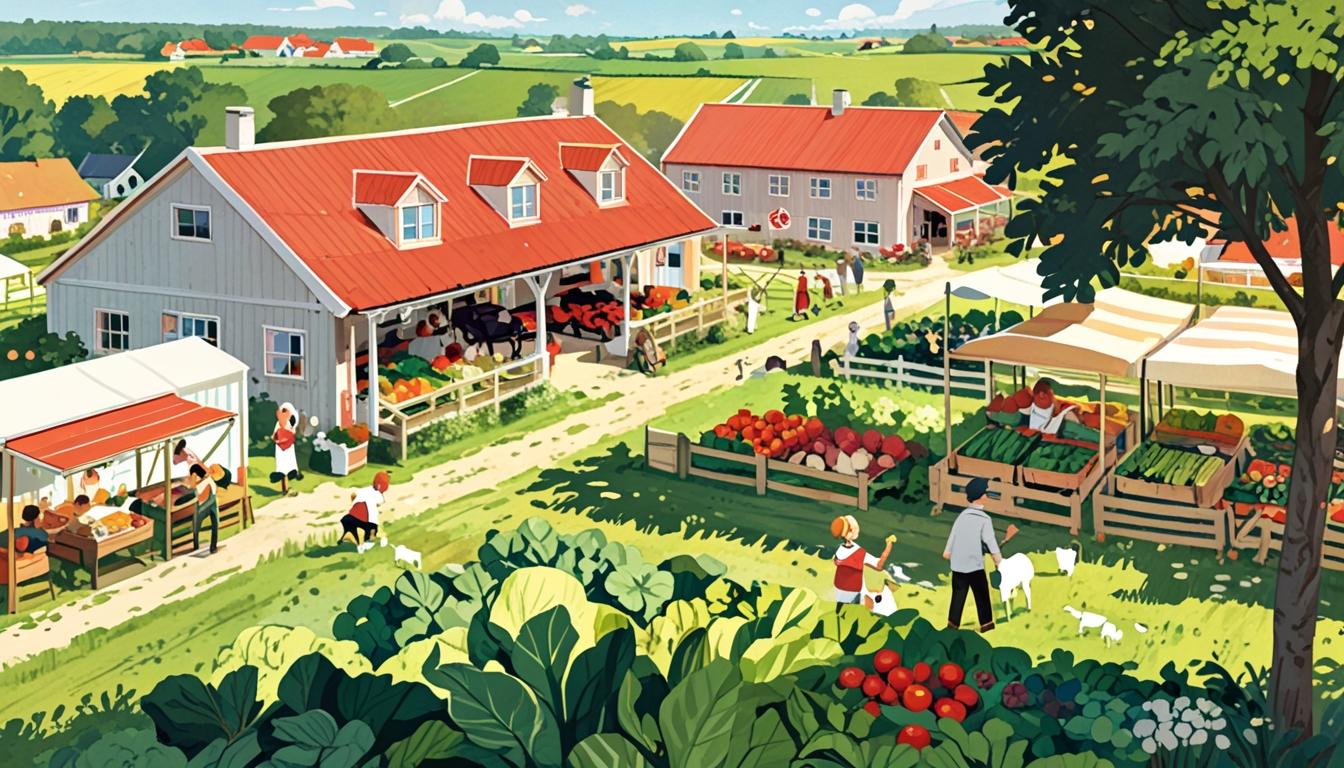
The agricultural landscapes of the Netherlands and Denmark, characterised by their flat terrains and abundant water, present unique opportunities for intensive farming. However, a marked contrast exists in their approach to organic food production. Denmark has distinguished itself as a leader in the organic food sector, while the Netherlands has consistently struggled to gain traction in this area.
Recent data indicates that approximately 40% of milk consumed in Denmark is organic, along with 55% of carrots and over 65% of bananas. Furthermore, organic products account for over 12% of total purchases in Danish supermarkets. In stark contrast, the Netherlands reports that just 3% of its food consumption stems from organic sources, with only 4% of its agricultural land dedicated to organic food production. This stagnation in organic growth places the Netherlands alongside countries such as Poland and Bulgaria, who also fall below the 5% threshold.
The data, brought to light by research from the think tank Questionmark, reveals that the Netherlands has adjusted its ambitions, aiming for only 15% of its agricultural land to be used for organic production by 2030, far below the European target of 25%. "The target is a political ambition and is not legally binding," stated a spokesperson from the Ministry of Agriculture. Meanwhile, Denmark has achieved approximately 14% organic land use, with Austria leading the way at 26%.
Katja Logatcheva, a market researcher at Wageningen University & Research, attributes this disparity to the historical context of Dutch agriculture, notably the post-war food scarcity that led the Netherlands to prioritise conventional food production. "The Netherlands faced food scarcity during the war, and the agreement was: never again. We became very successful in food production, aided by our fertile land," Logatcheva explained. This historical emphasis on maximising food output has made it difficult for the Netherlands to shift towards organic and sustainable practices.
Organic farming, known for its avoidance of synthetic fertilisers and chemical pesticides, is lauded for its ability to reduce greenhouse gas emissions and promote healthier food options. Denmark's commitment to organic food has roots in a long-term collaborative effort. Paul Holmbeck, who served as the director of Organic Denmark for 25 years, shared insights into how diverse political factions were brought together to support organic initiatives. "The more right-wing parties wanted to protect the small farmer, while for other parties it was about nature and climate. Ultimately, everyone could agree on the message," Holmbeck noted.
Danish initiatives have included ensuring that 60% of food provided in hospitals, daycare centres, and nursing homes is organic. This exposure has influenced consumer behaviour, with parents more inclined to purchase organic products for their homes. In terms of public engagement, the annual Økodag, or 'day of dancing cows', celebrates local food production and has grown significantly, attracting 200,000 visitors in recent years.
The transformation in Denmark’s supermarket ecosystem also took considerable time and investment, with a multi-million fund established to support Organic Denmark's efforts in developing retail strategies. This initiative has made organic products more visible and accessible within stores, contributing to their increased presence in the market.
In contrast, the Netherlands has not invested similar resources, leading to minimal change in the organic sector. Nonetheless, recent figures from Yougov indicate a rise in consumer spending on organic products, with an average increase of 32% per supermarket visit, reaching €5.51 last year. Strategies like in-store messaging, urging consumers to choose organic products through relatable comparisons, have reportedly boosted sales significantly.
Market researcher Logatcheva observes cultural pride in local food production as a contributing factor to Denmark’s success, emphasising that in successful countries like Denmark and Switzerland, there tends to be a more straightforward approach with fewer certification labels. "There are also fewer certification labels there: it's organic or it's not. Here, there are often more certification labels," she commented.
The contrasting trajectories of the Netherlands and Denmark in organic food production present a compelling study of agricultural policy, consumer behaviour, and historical context, highlighting the complexity of shifting towards sustainable practices.
Source: Noah Wire Services