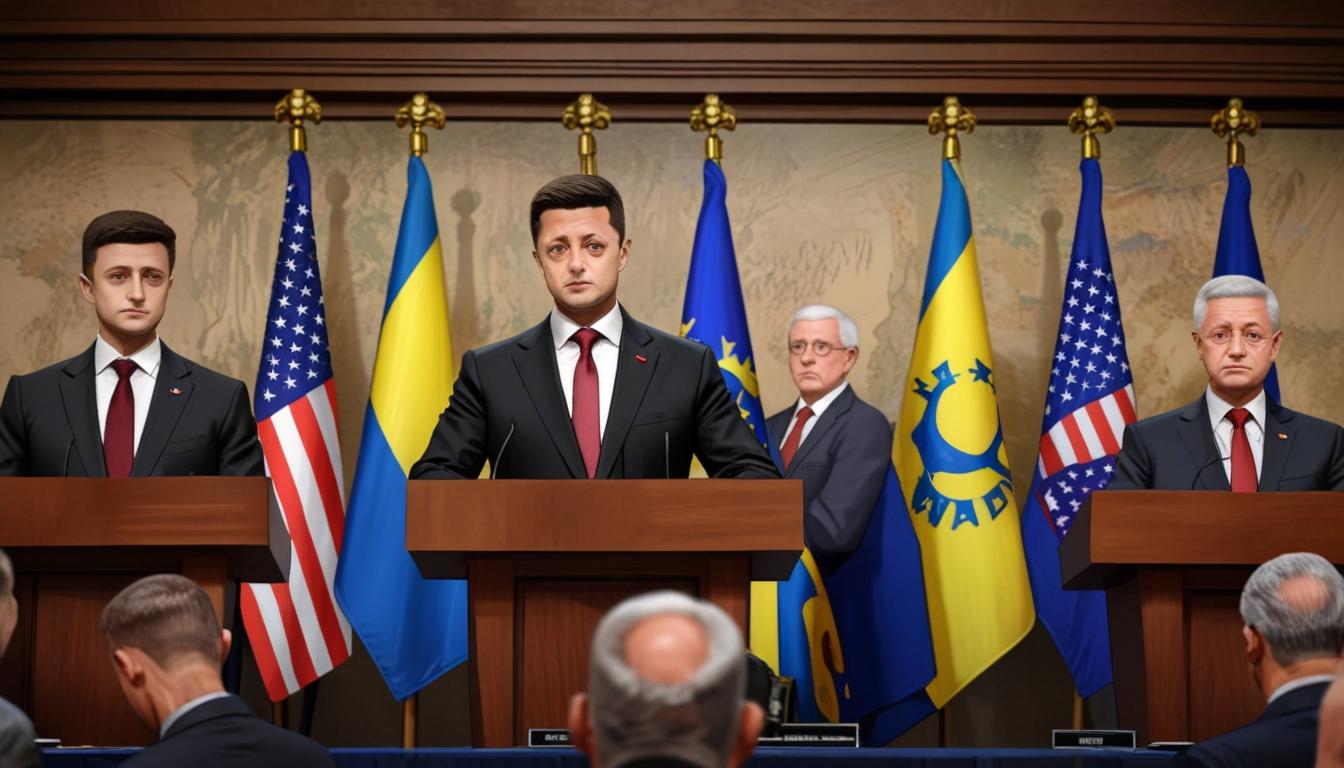
During a contentious press conference in the White House on Friday, Ukrainian President Volodymyr Zelensky found himself at the centre of a heated exchange with former U.S. President Donald Trump and current Vice President J.D. Vance. The interaction, which some observers are describing as a meticulously orchestrated ambush, raised questions about the dynamics of international diplomacy and the portrayal of Ukraine's leadership.
American President Trump referred to the spectacle as "great television," highlighting the dramatic nature of the confrontation. Analyst Tom Nichols, writing for The Atlantic, suggested that the event resembled a deliberate set-up aimed at undermining Zelensky, particularly given his less fluent command of English. The implication was that Trump and Vance might have sought to position Zelensky as an unreasonable figure compared to Russian President Vladimir Putin.
The U.S. and Ukraine appeared to be on the verge of signing a significant agreement—details of which remain unclear—when Trump unexpectedly dismissed Zelensky from the White House meeting. Initially designed as a potential resource agreement worth $500 billion, discussions seemed to shift towards U.S. investments in Ukraine's mining sector, along with exclusive mining concessions and revenue-sharing arrangements.
Zelensky fervently expressed the need for clear security guarantees from the U.S., emphasising that any future peace agreement with Russia would require military commitments not just from European partners but also from American forces. Trump, however, countered this demand, asserting that security and economic agreements were interconnected. "We will be in Ukraine, and that is a significant commitment from the United States," he stated, downplaying the need for traditional military guarantees.
Trump noted that security concerns constituted "only 2 percent of the problem" and proposed that American investments in the region would act as a deterrent against Russian aggression. He claimed that historical decisions made by his predecessor, President Biden, had led to the current conflict and ridiculed Biden for mere financial assistance to Ukraine, which he suggested was inadequate.
The atmosphere in the room escalated as tension mounted, with Trump allegedly fixating on his shoes and Zelensky gazing at the ceiling as the debate intensified. Vice President Vance further stoked disputes by praising Trump's diplomatic interactions with Putin, contrasting them unfavourably with Biden's approach. In response, Zelensky questioned the efficacy of diplomacy with a leader who had repeatedly violated agreements.
As the dialogue turned confrontational, Trump expressed his frustration, stating, "You are gambling with the lives of millions of people! You are gambling with World War III! What you’re doing is very disrespectful to this country." His remarks aimed at prompting Zelensky to consider a ceasefire to protect his nation's soldiers.
Speculation arose about whether Zelensky was set up for embarrassment or if his assertiveness unsettled his hosts, leading to an unexpected escalation. Observers noted the contrasting environments; Zelensky had previously received enthusiastic support from U.S. lawmakers, notably a standing ovation in Congress in 2022, yet was met with hostility in this recent engagement.
As events unfolded, the implications for international relations became apparent, with analysts suggesting that the U.S.'s stance on Ukraine could affect its alliances, particularly in Asia, where perceptions of reliability have begun to shift. The entire exchange has been documented and is available for viewing on YouTube, allowing a wider audience to engage with the full context of the discussion.
Source: Noah Wire Services