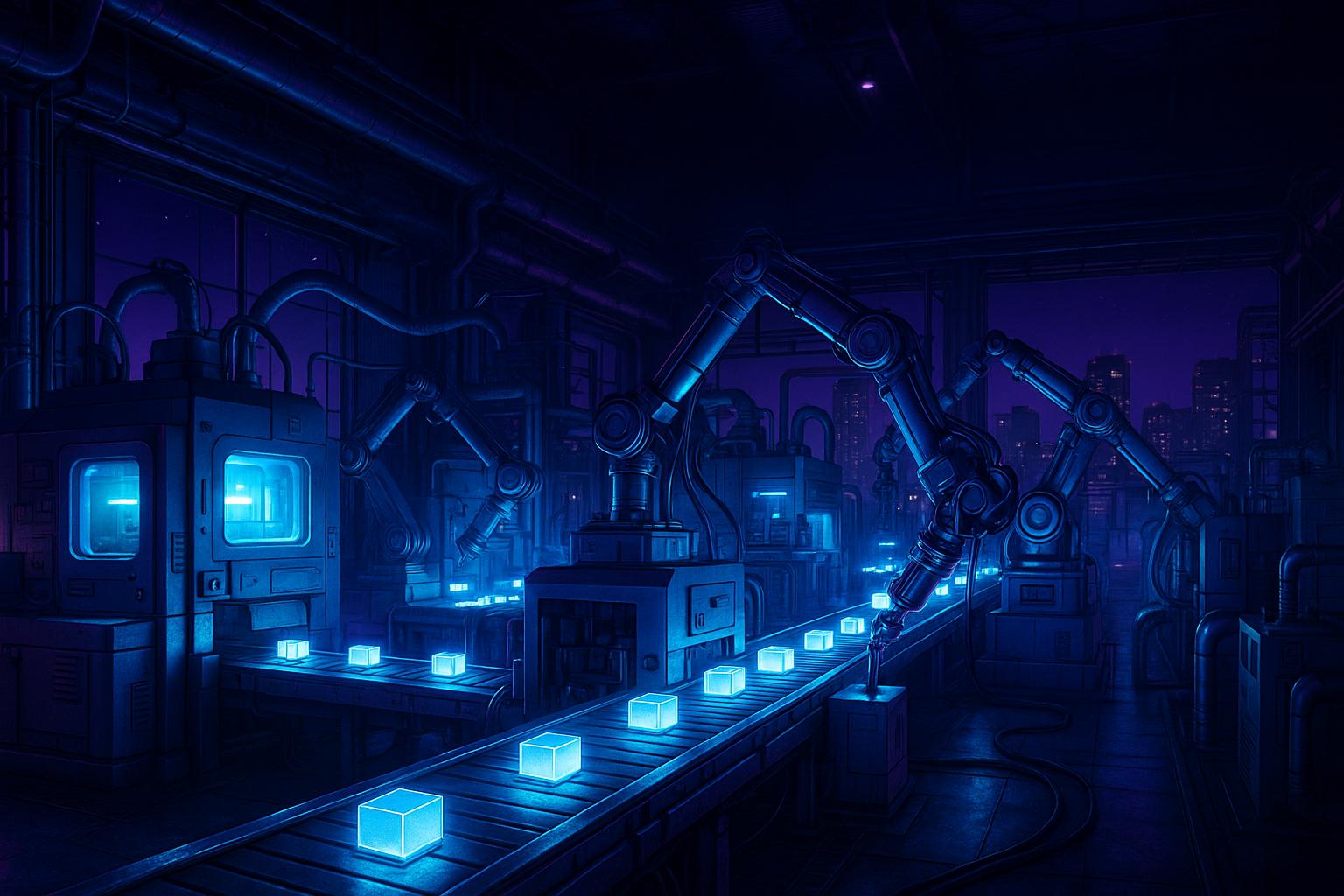
Siemens has introduced Digital Twin Composer, a software platform the company says will let manufacturers and supply‑chain operators create large‑scale, photorealistic Industrial Metaverse environments that tie engineering models to live factory data. According to Siemens' announcement at CES 2026, the tool fuses 2D and 3D digital‑twin assets from its Xcelerator portfolio with real‑time inputs and NVIDIA Omniverse libraries to produce managed, high‑fidelity visual scenes that reflect the physical state of equipment, lines and facilities.
The vendor frames the product as a way to collapse longstanding silos between design, simulation and operations by maintaining a single, continuously updated “living” model across a product or plant lifecycle. Siemens says the Composer can ingest feeds from manufacturing execution systems, quality platforms, PLCs and IIoT sensors and combine those with simulation and AI services such as RapidMiner to provide contextualised, near‑real‑time insight for planning and decision‑making. The company emphasised industrial scale and security, noting the platform is intended to support virtual validation and ongoing operation without replicating sensitive data across disconnected toolchains. “The new Digital Twin Composer delivers on our vision for the industrial metaverse. It helps manufacturers to overcome the unprecedented challenges of mastering complexity, accelerating production, reducing costs and increasing profitability,” said Joe Bohman, executive vice president, PLM Products, Siemens Digital Industries Software.
NVIDIA, whose Omniverse visualisation libraries underpin the Composer's rendering and physics, described the integration as enabling physically accurate simulation across lifecycle workflows. “By integrating NVIDIA Omniverse libraries into Digital Twin Composer, enterprises can take advantage of physically accurate simulation across their workflows to validate their entire lifecycle – from product design to factory logistics – in the virtual world before committing a single atom to the real one,” said Rev Lebaredian, vice president of Omniverse and Simulation Technology at NVIDIA.
Siemens and its partners have presented early commercial use cases to illustrate the claimed benefits. PepsiCo, in a company statement and Siemens case material, has been converting select US manufacturing and warehousing sites into high‑fidelity 3D twins to model plant operations and end‑to‑end logistics. According to PepsiCo's PR and Siemens’ communications, teams were able to establish performance baselines, iterate configurations in the digital environment and identify issues before physical changes were made. The partners report initial results including a roughly 20% uplift in throughput at an early deployment, near‑complete validation of designs prior to build and estimated capital‑expenditure reductions in the range of 10–15% by uncovering latent capacity. Siemens’ messaging also asserts that AI agents and computer‑vision models running in the virtual replica can detect up to 90% of potential problems before any hardware modifications occur.
Independent trade coverage and Siemens’ own blog posts repeat those figures and stress the speed of rollout, with pilots described as delivering measurable improvements within weeks or, in one account, three months. Industry commentators note those outcomes mirror broader objectives for digital‑factory initiatives, shortening design cycles, de‑risking investments and improving throughput, but caution that such gains depend on the quality of source data, integration effort and the maturity of an organisation's digital‑engineering practices.
The Composer is positioned as an addition to Siemens Xcelerator rather than a standalone replacement for existing PLM, simulation or automation tools; Siemens frames it as a means to thread those capabilities together into a continuous digital representation. The vendor is clear that the platform relies on an open ecosystem of engineering data and third‑party AI and visualisation technologies to deliver what it calls “virtual world intelligence.”
While vendors and early adopters highlight rapid returns in pilot settings, broader deployment typically requires work to harmonise data models, secure operational networks and adapt workflows across engineering and operations teams. Government and industry data show that successful digital‑twin programmes often proceed incrementally, from targeted proofs of concept to broader rollouts, so metrics achieved in pilot sites may not immediately generalise across larger, more heterogeneous estates.
Siemens has made the Composer available as part of its portfolio and is promoting the platform to manufacturers and logistics operators seeking faster design validation and continuous optimisation. The company points interested organisations to its corporate channels for further technical and commercial details.
Source: Noah Wire Services