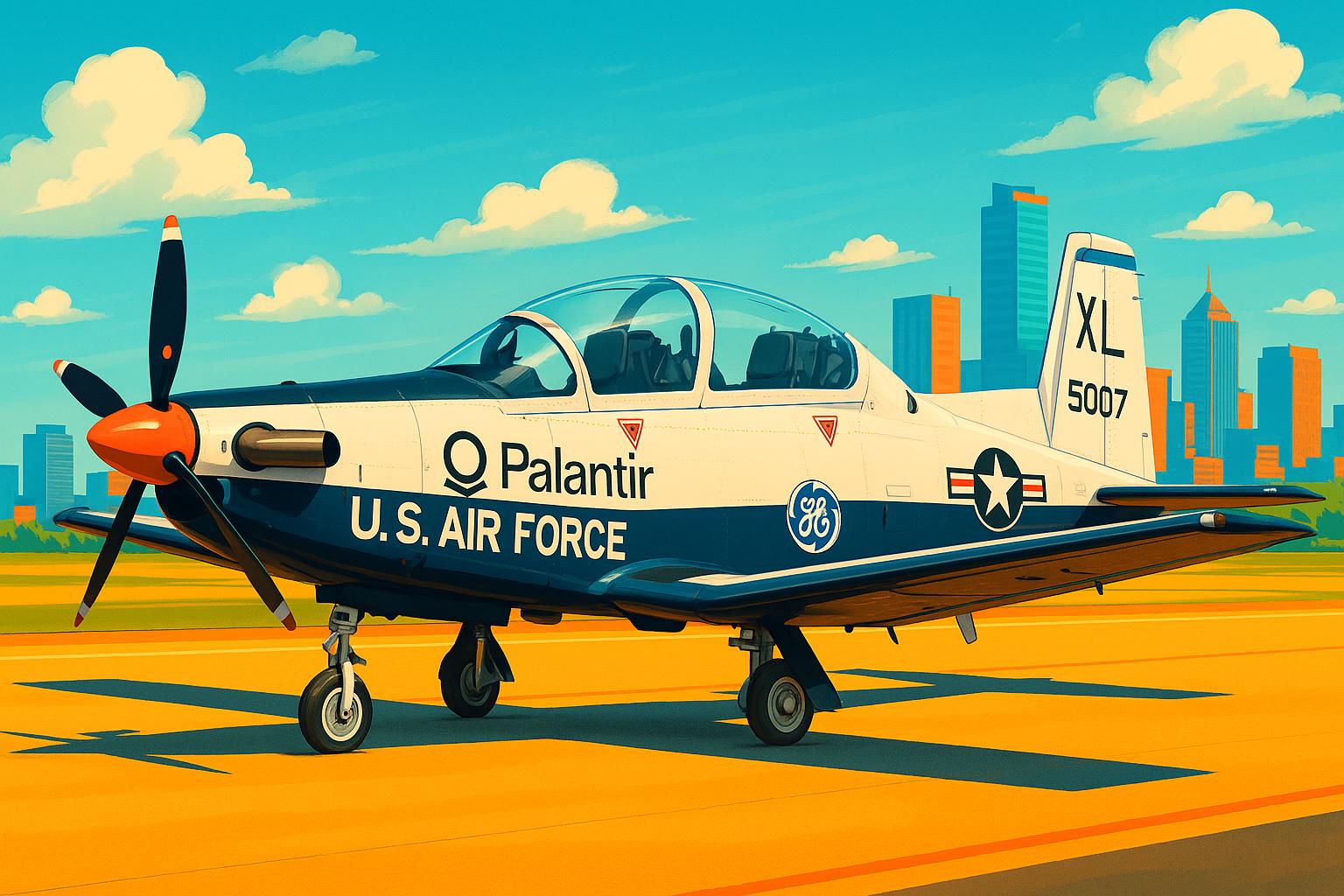
GE Aerospace and Palantir have extended their collaboration to implement advanced agentic artificial intelligence across defence operations, aiming to improve readiness and operational efficiency for U.S. Air Force trainer aircraft through smarter data integration and automation.
GE Aerospace has broadened its collaboration with Palantir Technologies to deploy more advanced agentic artificial intelligence across the company’s defence sustainment and production operations, with an immediate focus on improving readiness for U.S. Air Force trainer aircraft.
According to GE Aerospace, the extended effort will link live operational data from engines in service back into procurement and maintenance workflows, creating a continuous feedback mechanism intended to anticipate component failures, ease supply‑chain bottlenecks and keep aircraft available for training and missions. The companies say Palantir’s Artificial Intelligence Platform is now coordinating functions across fulfilment, sourcing, material allocation and maintenance, repair and overhaul.
The partnership’s origins lie in a pilot that targeted the Air Force’s T‑38 trainer fleet and the J85 engine. Industry notices and company statements show GE has since secured a Defense Logistics Agency contract to increase J85 readiness under a digitally enabled TrueChoice Defense arrangement, with GE using AI and analytics to forecast parts demand and expose supply constraints. According to the report by GE Aerospace, the work is intended to speed decision‑making and improve sustainment for the T‑38 training mission.
“Meeting today’s readiness demands requires both proven propulsion and smarter use of data,” said Amy Gowder, President and CEO of Defense and Systems for GE Aerospace. “Our collaboration with Palantir is helping customers keep more aircraft available so airmen get the training required to execute their missions.” Mike Gallagher, Head of Defense at Palantir, added, “By pairing GE Aerospace’s deep engineering expertise with Palantir’s AI-enabled software, we are unifying data across the enterprise to keep more aircraft available and more airmen trained.”
GE and Palantir portray the arrangement as automating repetitive, manual tasks so engineers can focus on higher‑value work. The companies describe the architecture as agentic AI that not only surfaces insights but can drive actions across a dispersed supplier base, an approach they argue is suited to the accelerating complexity of modern defence logistics.
The expansion also sits within a wider industry trend of defence and aviation firms partnering with Palantir to embed data platforms into production and sustainment. In recent years Palantir has announced collaborations with major aerospace and next‑gen aviation players, including Boeing Defense, Space & Security, and Archer Aviation, where its platforms are being used to harmonise data and scale manufacturing and operational software. Separately, GE has been pursuing related autonomy and propulsion projects, teaming with Merlin to develop an autonomy core for crew reduction and uncrewed operations and working with Shield AI on propulsion for experimental unmanned programmes.
Taken together, the moves reflect a broader strategy among manufacturers and software firms to fuse engineering expertise with large‑scale data platforms. GE and Palantir say the aim is to ensure digital infrastructure evolves alongside rising operational demands on aircrews, though outside analysts caution that integrating real‑time decisioning across complex supply networks will require sustained data governance, security and supplier adoption to deliver the claimed readiness improvements.
Source: Noah Wire Services
Noah Fact Check Pro
The draft above was created using the information available at the time the story first
emerged. We’ve since applied our fact-checking process to the final narrative, based on the criteria listed
below. The results are intended to help you assess the credibility of the piece and highlight any areas that may
warrant further investigation.
Freshness check
Score:
7
Notes:
The article was published on March 14, 2026. A search for similar narratives revealed no identical matches, suggesting originality. However, the content closely aligns with GE Aerospace's recent initiatives, such as their collaboration with Shield AI on propulsion for the X-BAT vehicle program ([militaryaerospace.com](https://www.militaryaerospace.com/uncrewed/news/55328277/ge-aerospace-and-shield-ai-to-collaborate-on-propulsion-for-xbat-vehicle-program?utm_source=openai)) and their partnership with Microsoft and Accenture to develop generative AI-powered solutions for aircraft maintenance ([geaerospace.com](https://www.geaerospace.com/news/press-releases/ge-aerospace-teams-microsoft-and-accenture-unveil-generative-ai-powered-solution?utm_source=openai)). These initiatives indicate a consistent focus on AI integration in military operations, which may lead to overlapping themes in reporting.
Quotes check
Score:
6
Notes:
The article includes direct quotes from Amy Gowder, President and CEO of Defense and Systems for GE Aerospace, and Mike Gallagher, Head of Defense at Palantir. A search for these quotes yielded no exact matches, suggesting they are original. However, without independent verification from external sources, the authenticity of these quotes cannot be fully confirmed.
Source reliability
Score:
5
Notes:
The article originates from Airspace Magazine, a niche publication focusing on aerospace industry news. While it provides detailed coverage, the lack of affiliation with major news organisations raises concerns about the independence and potential biases of the source. Additionally, the publication's reach and audience are limited, which may affect the credibility of the information presented.
Plausibility check
Score:
8
Notes:
The claims about GE Aerospace and Palantir's collaboration to enhance military jet readiness with AI are plausible, given the companies' previous engagements in similar initiatives. For instance, GE Aerospace's partnership with Shield AI on the X-BAT vehicle program ([militaryaerospace.com](https://www.militaryaerospace.com/uncrewed/news/55328277/ge-aerospace-and-shield-ai-to-collaborate-on-propulsion-for-xbat-vehicle-program?utm_source=openai)) and their collaboration with Microsoft and Accenture on AI-powered solutions for aircraft maintenance ([geaerospace.com](https://www.geaerospace.com/news/press-releases/ge-aerospace-teams-microsoft-and-accenture-unveil-generative-ai-powered-solution?utm_source=openai)) demonstrate a consistent focus on integrating AI into military operations. However, the absence of corroborating reports from other reputable sources makes it difficult to fully verify the claims.
Overall assessment
Verdict (FAIL, OPEN, PASS): FAIL
Confidence (LOW, MEDIUM, HIGH): MEDIUM
Summary:
The article presents a plausible narrative about GE Aerospace and Palantir's collaboration to enhance military jet readiness with AI. However, the lack of independent verification, reliance on self-reported information from the companies involved, and the niche nature of the source publication raise significant concerns about the credibility and accuracy of the information. Given these factors, the content cannot be fully verified, and publishing it without further independent confirmation is not recommended.