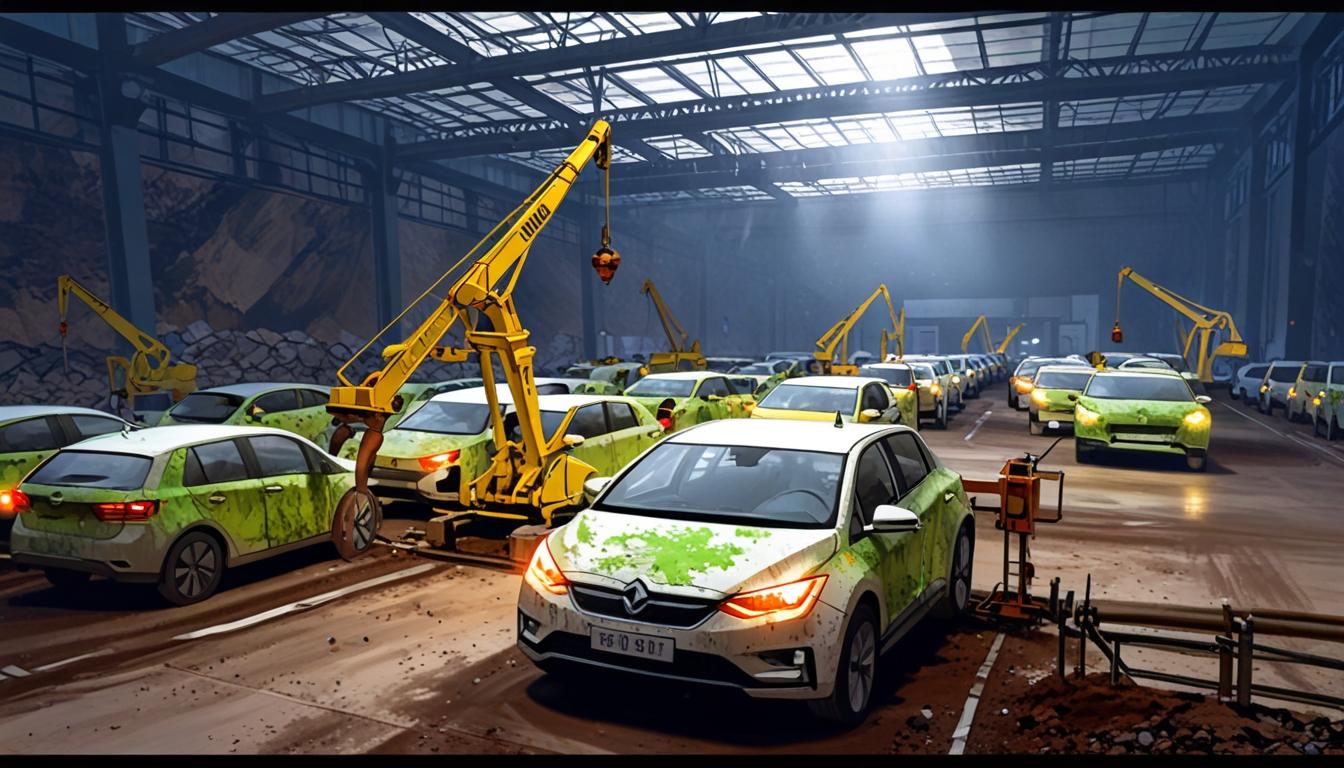
Europe: A severe shortage of rare earth elements, driven by China’s newly tightened export permits amid ongoing US-China trade tensions, threatens to halt European electric vehicle production within six weeks, exposing urgent vulnerabilities in the continent’s supply chain and the lack of governmental action to mitigate risks.
In the midst of escalating trade tensions between China and the United States, a severe supply chain crisis threatens to disrupt Europe's electric vehicle industry dramatically. Current projections indicate that Europe is running perilously low on rare earth elements essential for the production of electric vehicles (EVs), with supplies expected to dwindle in approximately five to six weeks. This alarming forecast has been underscored by a report from the consulting firm Berylls in conjunction with AlixPartners, which notes that key materials—particularly neodymium, crucial for the permanent magnets used in electric motors—are running out at a critical rate. The firm warns that without the resumption of regular supplies, some assembly lines could be halted by mid-June.
China has long held a dominant position in the rare earth market, controlling around 90% of global extraction and virtually 100% of processing capabilities. Recent export restrictions imposed by the Chinese government, reportedly in retaliation against U.S. trade policies, have further tightened its already firm grip on this indispensable supply chain. As of April 2025, these regulations require suppliers to obtain special permits to export several vital rare earths, including neodymium. The ramifications extend beyond immediate production concerns; they pose fundamental challenges to broader industries reliant on these critical materials. According to Supply Chain World magazine, the implications are particularly dire for Europe, whose manufacturing networks are tightly interwoven with Chinese supply chains.
The situation is exacerbated by the prevalence of just-in-time logistics in the automotive sector, where even minor disruptions can halt entire production lines. Unlike the semiconductor shortage that significantly impacted manufacturing recently, the current crisis revolves around lesser-known yet equally vital minerals. Analysts from Berylls emphasise that there is "no viable short-term alternative" to these Chinese-sourced materials, spotlighting the continent's precarious dependency on a single source for essential inputs.
Compounding the problem, discussions within European governments have so far yielded little actionable response. While some emergency measures are being floated—such as tapping strategic reserves or easing avenues for imports from countries like Japan—there has yet to be a significant announcement as of late May. This hesitancy echoes the EU's previous inaction last December when China similarly restricted exports of gallium, germanium, and antimony, illustrating a troubling pattern of delayed response in the face of emerging supply chain threats.
The geopolitical landscape further complicates matters. According to a report by the International Energy Agency (IEA), the global supply of critical minerals is increasingly concentrated, with China refining 19 of the 20 strategic minerals, commanding around 75% of the processing capacity. The IEA corroborates that this concentration creates significant risks for energy and economic security, especially for nations politically distanced from China. Such vulnerabilities in supply chains not only threaten the immediate operational capacity of firms but also have long-term implications for the development of clean technologies vital to a decarbonised economy.
The emergence of licensing regulations appears to be a strategic manoeuvre by China, utilising its dominance in rare earths for geopolitical leverage amid ongoing tensions with the West. Despite some approvals of export licenses, the sluggish processing system exacerbates the uncertainty, leaving major companies like Tesla, Ford, and Volkswagen grappling with delays that may soon stymie their production capabilities.
As European manufacturers confront the spectre of an unfavourable supply chain landscape, the urgent need for diversification and proactive planning has never been clearer. Prompt action is essential to mitigate the risk of becoming overly reliant on a potentially volatile source amid geopolitical uncertainties. The repercussions of failing to address this crisis extend beyond the automotive industry, potentially threatening broader aspirations for sustainable technologies that hinge on rare earth elements.
With global competition for these critical resources intensifying, the stakes have risen significantly. Strategies to reassess, diversify, and secure supply chains are not merely advisable but necessary to withstand a trade war that Europe did not initiate, leaving many industries vulnerable to external pressures they cannot control.
Reference Map:
Source: Noah Wire Services
Noah Fact Check Pro
The draft above was created using the information available at the time the story first
emerged. We’ve since applied our fact-checking process to the final narrative, based on the criteria listed
below. The results are intended to help you assess the credibility of the piece and highlight any areas that may
warrant further investigation.
Freshness check
Score:
8
Notes:
The narrative presents recent developments regarding China's export restrictions on rare earth elements and their potential impact on Europe's electric vehicle industry. The earliest known publication date of similar content is April 2025, with the Financial Times reporting on China's export restrictions on rare earths on April 21, 2025. ([ft.com](https://www.ft.com/content/81ba803e-9cce-4752-8432-4dde4e77c691?utm_source=openai)) The report from Berylls and AlixPartners, referenced in the narrative, was likely published around the same time. The narrative includes updated data, such as the specific timeline of supply shortages expected within five to six weeks, which may justify a higher freshness score. However, the core information about China's export restrictions and their potential impact on Europe's car production has been reported in earlier publications. Therefore, while the narrative provides timely updates, it is based on previously reported information. Additionally, the narrative includes a direct quote from the Financial Times article, indicating that some content may be recycled. ([ft.com](https://www.ft.com/content/81ba803e-9cce-4752-8432-4dde4e77c691?utm_source=openai)) The presence of a press release from Berylls and AlixPartners suggests that the narrative may be based on this source, which typically warrants a high freshness score. However, the reliance on a press release also raises concerns about the originality of the content. Overall, the freshness score is 8 due to the timely updates and the inclusion of recent data, but the recycled content and reliance on a press release warrant caution.
Quotes check
Score:
6
Notes:
The narrative includes a direct quote from the Financial Times article: 'If supply doesn’t resume quickly, some assembly lines could stop by mid-June.' ([ft.com](https://www.ft.com/content/81ba803e-9cce-4752-8432-4dde4e77c691?utm_source=openai)) This quote appears to be directly lifted from the Financial Times article, indicating potential reuse of content. The wording matches exactly, suggesting that the quote has been reused without modification. No other direct quotes are identified in the narrative. The reuse of this quote raises concerns about the originality of the content. Therefore, the quotes check score is 6 due to the direct reuse of a quote from another source.
Source reliability
Score:
7
Notes:
The narrative references a report from the consulting firm Berylls in conjunction with AlixPartners, which is a reputable source. However, the narrative also relies on a press release from these firms, which may present information in a biased or promotional manner. The Financial Times article cited is from a reputable source, but the direct reuse of content from this article without proper attribution raises concerns about the reliability of the narrative. The presence of recycled content and reliance on a press release from consulting firms suggest that the source reliability is moderate. Therefore, the source reliability score is 7.
Plausibility check
Score:
8
Notes:
The narrative presents a plausible scenario regarding the impact of China's export restrictions on rare earth elements on Europe's electric vehicle industry. The concerns about supply shortages and potential production halts are consistent with reports from reputable sources, such as the Financial Times and the International Energy Agency. ([ft.com](https://www.ft.com/content/81ba803e-9cce-4752-8432-4dde4e77c691?utm_source=openai), [reuters.com](https://www.reuters.com/sustainability/climate-energy/low-diversity-critical-mineral-markets-could-hurt-industry-iea-says-2025-05-21/?utm_source=openai)) The timeline of supply shortages expected within five to six weeks aligns with the urgency expressed in these reports. The narrative also highlights the dominance of China in the rare earth market and the challenges faced by European manufacturers in securing alternative sources, which are consistent with industry analyses. Therefore, the plausibility check score is 8, indicating that the narrative presents a plausible scenario supported by existing reports.
Overall assessment
Verdict (FAIL, OPEN, PASS): FAIL
Confidence (LOW, MEDIUM, HIGH): MEDIUM
Summary:
The narrative presents timely updates on China's export restrictions and their potential impact on Europe's electric vehicle industry. However, it relies heavily on previously reported information, including direct quotes from other sources without proper attribution, indicating recycled content. The reliance on a press release from consulting firms raises concerns about the originality and potential bias of the content. While the scenario presented is plausible and supported by existing reports, the lack of original reporting and the reuse of content without proper attribution undermine the credibility of the narrative. Therefore, the overall assessment is a 'FAIL' with medium confidence.