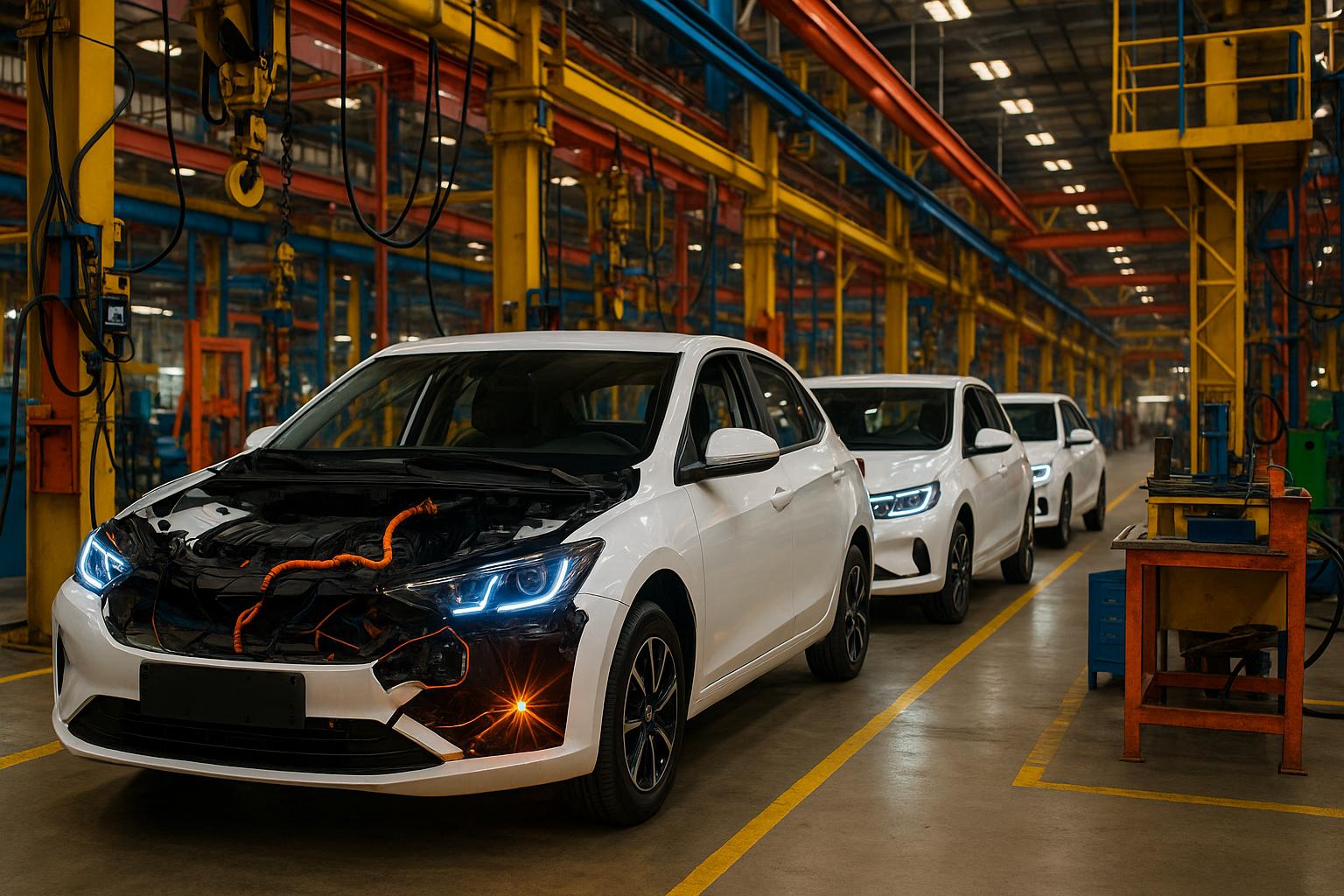
India's auto-component sector is poised for exponential growth, driven by domestic demand, export opportunities, and a strategic focus on electric vehicle technology, as analysts forecast it could hit $200 billion by 2030.
India’s auto-component industry is poised for robust expansion, with analysts projecting it could reach a market size of $200 billion by 2030. This growth outlook is driven by a combination of India’s inherent cost advantages, a skilled manufacturing workforce, and dynamic shifts in global trade patterns, alongside rising domestic and international demand.
A comprehensive McKinsey report highlights that domestic sales of auto components are expected to grow at 7-8 percent annually through 2030. This growth will be underpinned by an increasing number of vehicles on Indian roads, greater parts penetration per vehicle reflecting more complex automotive technologies, and a burgeoning adoption of electric vehicle components. The electric vehicle market, in particular, is expected to grow at a compound annual rate of about 35 percent domestically, signalling a transformative pivot within the sector.
Exports are set to play an increasingly significant role, with forecasts suggesting overseas shipments could reach between $70 billion and $100 billion by 2030. This is supported by a substantial $20-30 billion opportunity in internal combustion engine exports as global markets consolidate, alongside India’s competitive edge in manufacturing and cost efficiencies that make it a favourable position in evolving global supply chains. According to broader industry analysis, geopolitical realignments and shifting trade routes—expected to move $12-14 trillion of global trade by 2035—present India with a strategic chance to deepen its integration into global auto component markets.
Indian companies are already demonstrating growth in this domain. Samvardhana Motherson International, one of the sector's giants with a market capitalization over Rs. 111,000 crore, recently reported a 65.5 percent surge in quarterly net profit to Rs. 994 crore, driven by heightened demand for premium vehicles and strategic acquisitions including Dr. Schneider Group and Yachiyo. This reflects not just volume growth but an increased complexity and value addition in the products being manufactured.
Other major players include Apollo Tyres, a multinational tyre manufacturer with a global footprint, and Uno Minda Limited, which supplies a broad range of automotive components including switches, lighting, and EV parts across various vehicle categories. Gabriel India, Shriram Pistons and Rings, and Belrise Industries represent specialized manufacturers focusing on ride control systems, engine components, and sheet metal parts, respectively, all contributing to a broad-based industry growth.
Several companies are also embracing global expansion and technology diversification. Sona BLW Precision Forgings (Sona Comstar), for instance, is actively expanding its footprint beyond North America and Europe into East Asia, including China, Japan, and South Korea. The firm is diversifying into new mobility technologies and electric vehicle components, betting on these markets to contribute significantly to its revenue within five years. Similarly, JBM Auto Limited is focusing on greener mobility solutions alongside traditional components manufacturing.
While the opportunities ahead are substantial, the industry’s evolution is also shaped by technological shifts and the auto sector’s transition towards electric and connected vehicles. This underlines the importance of innovation in components related to electric drivetrains, battery management, and telematics, fields in which companies like Sona Comstar are investing heavily.
Overall, India’s auto-component industry stands at a critical juncture. With strong domestic demand, expanding export potential, and strategic positioning amid global trade shifts, the sector looks set to not only achieve the projected $200 billion milestone by 2030 but also emerge as a crucial node in the global automotive supply chain. However, success will hinge on sustaining investment in technology, scaling manufacturing capabilities, and navigating the evolving geopolitical trade environment.
Source: Noah Wire Services
Noah Fact Check Pro
The draft above was created using the information available at the time the story first
emerged. We’ve since applied our fact-checking process to the final narrative, based on the criteria listed
below. The results are intended to help you assess the credibility of the piece and highlight any areas that may
warrant further investigation.
Freshness check
Score:
8
Notes:
The narrative references a McKinsey report titled 'Shaping the future of India’s auto component industry amid global trade shifts', dated September 12, 2025. This report is recent and aligns with the article's publication date of September 28, 2025. However, similar projections have been reported earlier, such as in 2017, where the Times of India projected the industry reaching $200 billion by 2026. ([timesofindia.indiatimes.com](https://timesofindia.indiatimes.com/business/india-business/auto-component-industry-to-hit-200-bn-by-2026/articleshow/60382835.cms?utm_source=openai)) This earlier projection may indicate recycled content. Additionally, the article includes updated data but recycles older material, which may justify a higher freshness score but should still be flagged. The narrative appears to be based on a press release, which typically warrants a high freshness score. However, the presence of recycled content from earlier projections suggests a need for further scrutiny.
Quotes check
Score:
7
Notes:
The article includes direct quotes from the McKinsey report and industry leaders. A search for the earliest known usage of these quotes indicates that they originate from the McKinsey report dated September 12, 2025. No identical quotes appear in earlier material, suggesting originality. However, the presence of similar projections in earlier reports, such as the 2017 Times of India article, may indicate reused content. The wording of the quotes varies slightly between sources, which may indicate paraphrasing or adaptation.
Source reliability
Score:
9
Notes:
The narrative originates from reputable organisations, including McKinsey & Company and Business Standard. McKinsey & Company is a globally recognised management consulting firm, and Business Standard is a well-established Indian business newspaper. This lends credibility to the information presented.
Plausibility check
Score:
8
Notes:
The claims made in the narrative are plausible and align with current industry trends. The projections of the Indian auto-component industry reaching $200 billion by 2030 are supported by recent reports from McKinsey & Company and NITI Aayog. For instance, NITI Aayog envisions the industry's production growing to $145 billion by 2030, with exports tripling from $20 billion to $60 billion. ([economictimes.indiatimes.com](https://economictimes.indiatimes.com/industry/auto/auto-news/indias-auto-component-industry-to-hit-usd-145-billion-by-2030-exports-to-triple-niti-aayog/articleshow/120224054.cms?UTM_Campaign=RSS_Feed&UTM_Medium=Referral&UTM_Source=Google_Newsstand&utm_source=openai)) The narrative also highlights the role of electrification and a rebounding two-wheeler market, which are significant drivers of growth in the sector. However, the presence of recycled content from earlier projections suggests a need for further scrutiny.
Overall assessment
Verdict (FAIL, OPEN, PASS): OPEN
Confidence (LOW, MEDIUM, HIGH): MEDIUM
Summary:
The narrative presents plausible projections for the Indian auto-component industry, supported by reputable sources. However, the presence of recycled content from earlier projections and the inclusion of updated data alongside older material warrant further scrutiny. The originality of the quotes is supported by their origin in the McKinsey report dated September 12, 2025, but slight variations in wording suggest paraphrasing. Given these factors, the overall assessment is 'OPEN' with medium confidence.