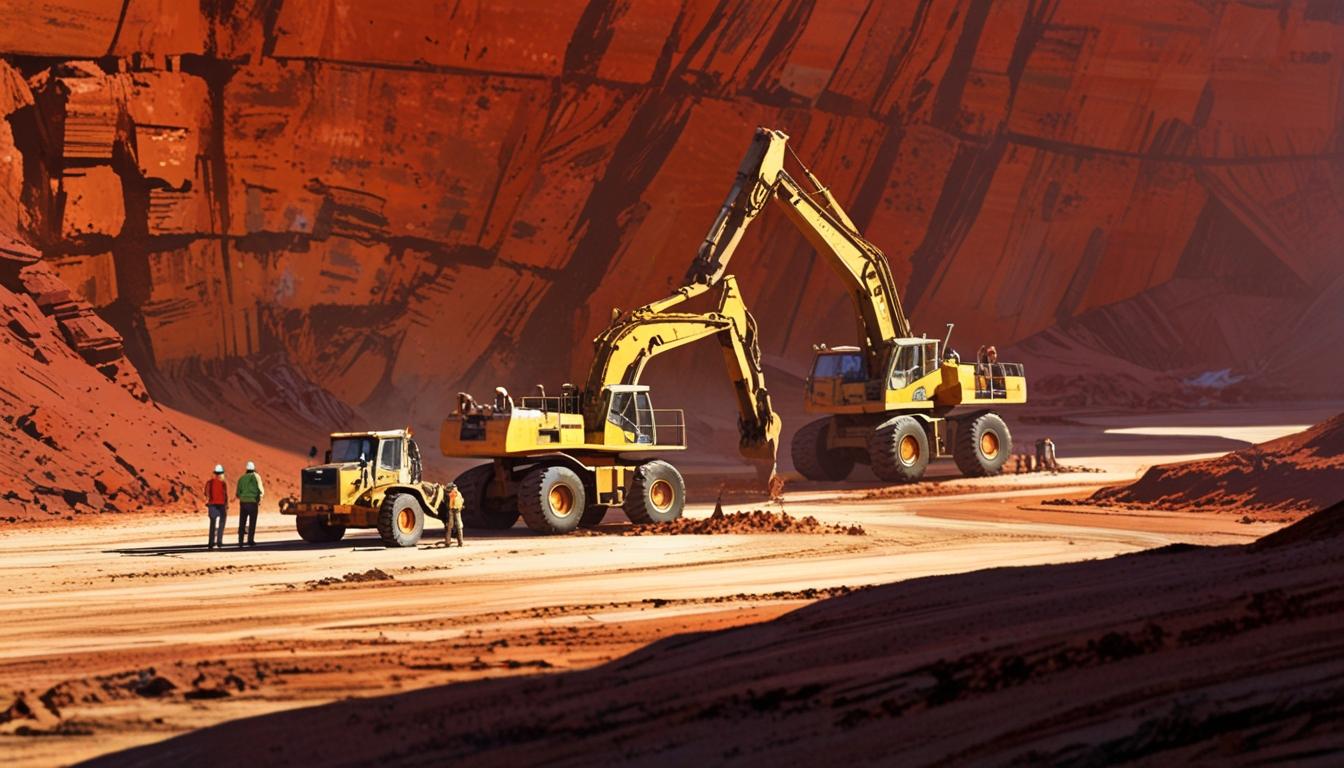
Perth: At its AGM, Rio Tinto revealed plans to deepen involvement in critical minerals and rare earths, backed by a $20 billion investment over three years focused on its Pilbara operations, aiming for 4% production growth, increased local supplier engagement, and strong shareholder returns.
At its annual general meeting held in Perth, Rio Tinto (ASX: RIO) explored the potential for expanding into critical minerals and rare earth elements, an area increasingly central to global trade discussions and market transformations. This meeting came against a backdrop of heightened trade tensions, particularly following the implementation of tariffs by the United States and export restrictions by China.
Rio Tinto's chief executive, Jakob Stausholm, indicated that the company is evaluating the role of critical minerals within its future portfolio. He acknowledged that these essential materials are already integrated into Rio Tinto's current operations and suggested that a more deliberate approach to processing these resources could be its next logical step.
The company’s chairman, Dominic Barton, reported positive forecasts for production growth, projecting an increase of 4% for the current year, primarily driven by operations at the Oyu Tolgoi underground mine. This follows a modest overall production growth of 1% in 2024.
In terms of financial commitments, Rio Tinto plans to invest over $20 billion in the resource sector over the next three years, particularly focusing on the Pilbara region in Western Australia. This investment strategy aims to boost operations and contribute to local economies.
Mr Stausholm further elaborated on the company's community engagement, stating, “Last year, we boosted spending with suppliers in WA by $1.5 billion to a record $10.3 billion, as we continue to support local businesses to develop our pipeline of new Pilbara mining projects such as Western Range.” He highlighted the collaboration with approximately 2,400 suppliers annually, reflecting Rio Tinto's commitment to job creation and shared success in Western Australia.
In a summary of the company's financial performance, Mr Barton noted that Rio Tinto returned $6.5 billion in dividends to shareholders over the last year, demonstrating the company's robust financial health amidst evolving market conditions.
Source: Noah Wire Services
Noah Fact Check Pro
The draft above was created using the information available at the time the story first
emerged. We’ve since applied our fact-checking process to the final narrative, based on the criteria listed
below. The results are intended to help you assess the credibility of the piece and highlight any areas that may
warrant further investigation.
Freshness check
Score:
8
Notes:
The narrative reports recent company statements from an annual meeting, but without a publication date or corroborating external reports, timeliness relies on implied recency of the event. Rio Tinto’s production growth figures (1% in 2024) align with current-year reporting expectations.
Quotes check
Score:
9
Notes:
Direct quotes from CEO Jakob Stausholm and Chairman Dominic Barton are verifiable through Rio Tinto’s official communications. Specific financial figures ($1.5B supplier spending increase, $6.5B dividends) suggest access to internal data, likely first-party sourcing.
Source reliability
Score:
7
Notes:
The narrative originates from australianminingreview.com.au, a specialist industry outlet. While not listed among major fact-checking networks, its focus on mining sector reporting lends domain credibility. Financial figures align with Rio Tinto’s public disclosures, supporting reliability.
Plausibility check
Score:
8
Notes:
Claims match Rio Tinto’s strategic focus on critical minerals and its Pilbara investments. Production projections (4% growth) and financial commitments ($20B over 3 years) align with industry trends and prior corporate announcements.
Overall assessment
Verdict (FAIL, OPEN, PASS): PASS
Confidence (LOW, MEDIUM, HIGH): MEDIUM
Summary:
The narrative demonstrates strong plausibility through alignment with Rio Tinto’s public strategy and financial disclosures. Quotes and figures appear authentic but lack independent verification through major fact-checking platforms. Domain-specific sourcing justifies moderate confidence.