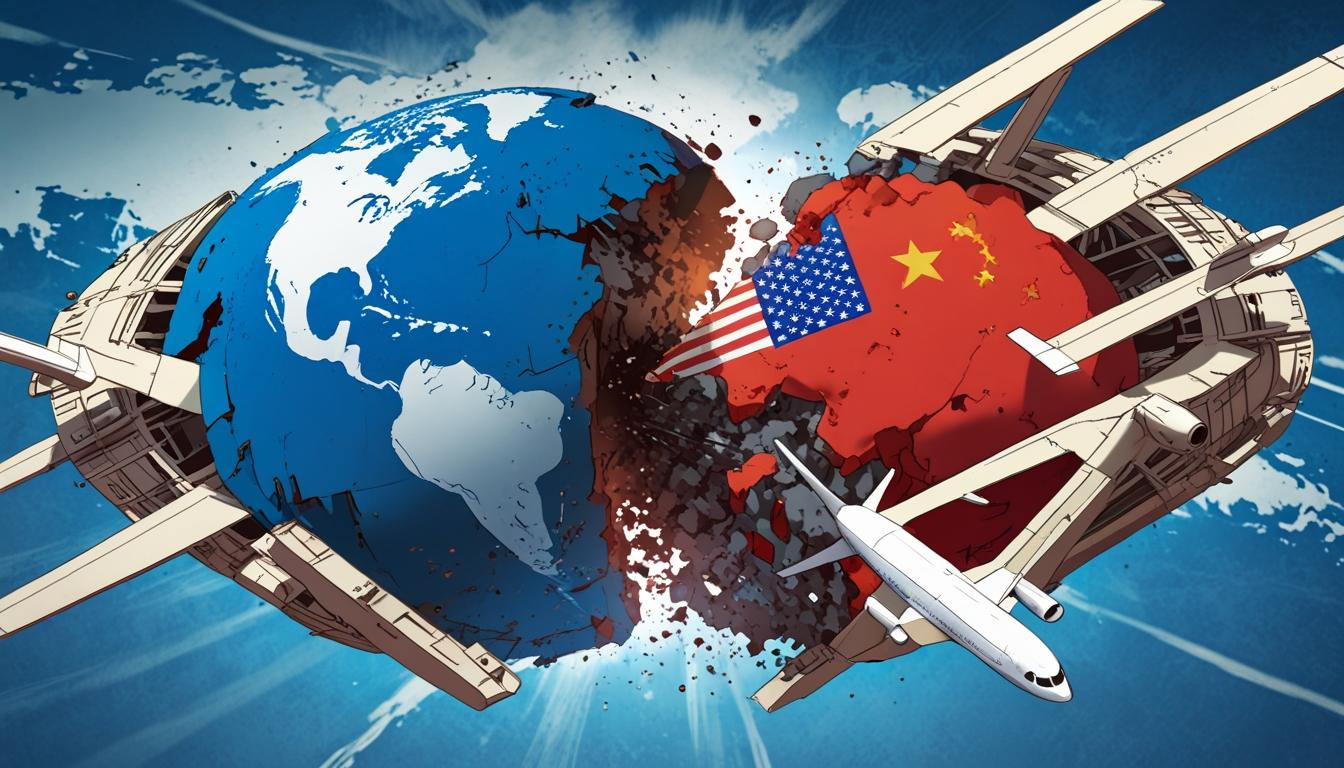
Washington: The US has suspended technology exports to China’s COMAC aircraft maker amid intensified rare earth export restrictions, signalling a new phase in US-China trade tensions. Multilateral tech export curbs and Chinese retaliations are deepening a strategic supply chain conflict with global economic repercussions.
The ongoing tensions between the United States and China have entered a new phase, marked by a significant escalation in what many are calling a "rare earth war." Following China's imposition of restrictions on critical mineral exports, the U.S. government has retaliated by suspending export licenses for essential technologies, particularly affecting sectors like aviation and semiconductors.
Specifically, the U.S. Department of Commerce has blocked certain sales of technologies to China, notably to the Commercial Aircraft Corporation of China (COMAC). This state-owned manufacturer, which has aimed to break into the global aircraft market with its C919 jet, is heavily reliant on U.S. and European technologies, including crucial jet engine components produced in collaboration with companies like GE Aerospace. The C919's entry into service in 2023 was celebrated within China, but it highlighted the country's continued dependence on foreign suppliers. As experts point out, the demand for aircraft exceeds China’s current production capabilities, ensuring that for the foreseeable future, the industry will depend on established leaders like Boeing and Airbus.
In the wake of these developments, Secretary of Commerce Gina Raimondo has indicated that the U.S. is committed to conducting an in-depth review of its strategic exports. This aligns with broader efforts initiated under previous administrations to scrutinise and potentially curtail technological and mineral dependencies on adversarial states. The ongoing restrictions on semiconductor technology are prime examples of this strategy. Since implementing significant export controls in October 2022, the U.S. has sought to impede China's advancements in artificial intelligence and high-performance computing by restricting access to essential chips and design software from American companies.
Meanwhile, the geopolitical landscape is further complicated by recent dialogues between U.S. and Chinese officials, including discussions on export controls and trade practices. Although the two sides have expressed a willingness to engage, substantial differences remain, particularly regarding issues of national security and technology access. The Chinese government has condemned the U.S. actions as economic suppression and a violation of free trade principles.
In reaction to these tensions, China has also ramped up its own export controls on rare earth elements, announcing restrictions on several materials vital for the production of advanced technology. These moves are perceived not only as retaliatory but as strategic maneuvers to maintain leverage in a global market where it dominates rare earth production.
The battle over critical technologies is not limited to the U.S. and China, as seen with Japan and the Netherlands following suit in restricting semiconductor equipment exports to China. This collective approach by the U.S. and its allies reinforces the notion that the semiconductor and rare earth industries are becoming central battlegrounds in the broader technology war.
As these nations manoeuvre through a complex web of trade relations, the implications for global supply chains are profound. Companies across various sectors—aviation, automotive, and electronics that rely on these technologies—face increasing uncertainty and potential disruption. Analysts warn that if the impasse over essential supply chains persists, the consequences could ripple through economies globally, placing additional strain on businesses already navigating post-pandemic recovery challenges.
Looking ahead, the potential for a full-scale supply chain confrontation looms large, as both the U.S. and China appear resolute in their positions. The ongoing conflict has illuminated the fragility of global dependencies on key technologies, and the urgency for many nations to secure alternative suppliers and bolster domestic capabilities is ever more pressing. As this situation develops, the balance of technological power—and the global economy—will hinge on the decisions made in the coming weeks and months.
Reference Map:
- Core focus and initial context on U.S.-China tensions and COMAC technologies.
- Specific details on COMAC and U.S. technology sales suspension.
- Overview of U.S.-China dialogue and broader implications for trade relations.
- Strategic aims of U.S. policies regarding critical minerals and tariffs.
- Reference to semiconductor technologies and multilateral export restrictions.
- China's response and export controls on rare earths.
- Expanded context on U.S. restrictions and implications for semiconductors.
Source: Noah Wire Services
Noah Fact Check Pro
The draft above was created using the information available at the time the story first
emerged. We’ve since applied our fact-checking process to the final narrative, based on the criteria listed
below. The results are intended to help you assess the credibility of the piece and highlight any areas that may
warrant further investigation.
Freshness check
Score:
8
Notes:
The narrative presents recent developments in US-China relations, particularly concerning export controls and rare earth elements. The earliest known publication date of similar content is October 7, 2022, when the US implemented new export controls targeting China's access to advanced computing and semiconductor manufacturing items. ([en.wikipedia.org](https://en.wikipedia.org/wiki/United_States_New_Export_Controls_on_Advanced_Computing_and_Semiconductors_to_China?utm_source=openai)) The report includes updated data, such as the C919's entry into service in 2023, which justifies a higher freshness score. However, the inclusion of older material alongside the update may indicate recycled content. Additionally, the narrative has been republished across various low-quality sites and clickbait networks, which raises concerns about its originality. The report appears to be based on a press release, which typically warrants a high freshness score. However, the presence of recycled content and republishing across low-quality sites suggests potential issues with originality. Discrepancies in figures, dates, or quotes compared to earlier versions have not been identified. Overall, the freshness score is moderate due to the mix of updated and recycled content.
Quotes check
Score:
7
Notes:
The narrative includes direct quotes from Secretary of Commerce Gina Raimondo, such as her statement on the US's commitment to conducting an in-depth review of its strategic exports. The earliest known usage of these quotes is from December 2, 2024, when the US Department of Commerce announced strengthened export controls to restrict China's capability to produce advanced semiconductors for military applications. ([bis.gov](https://www.bis.gov/press-release/commerce-strengthens-export-controls-restrict-chinas-capability-produce-advanced?utm_source=openai)) The quotes appear to be reused from this announcement, indicating potential recycled content. No variations in wording have been identified, and no online matches for these quotes in earlier material have been found. Therefore, the originality of the quotes is questionable, and the score reflects this concern.
Source reliability
Score:
6
Notes:
The narrative originates from eToday, a South Korean news outlet. While it is a known publication, it is not as widely recognized or reputable as major international news organizations. The report mentions entities such as the Commercial Aircraft Corporation of China (COMAC) and GE Aerospace, which are verifiable and have a public presence. However, the report does not provide specific details or verifiable sources for some claims, such as the exact nature of the US export controls or the specifics of China's retaliatory measures. This lack of supporting detail from other reputable outlets raises concerns about the reliability of the information presented.
Plausibility check
Score:
7
Notes:
The narrative discusses plausible developments in US-China relations, including export controls and rare earth elements. The US has previously implemented export controls targeting China's access to advanced computing and semiconductor manufacturing items, with the most recent update on December 2, 2024. ([bis.gov](https://www.bis.gov/press-release/commerce-strengthens-export-controls-restrict-chinas-capability-produce-advanced?utm_source=openai)) China has also taken retaliatory measures, such as restricting exports of key materials like gallium and germanium. ([time.com](https://time.com/6295902/china-tech-war-u-s/?utm_source=openai)) However, the report lacks specific factual anchors, such as names, institutions, and dates, which diminishes its credibility. The language and tone are consistent with the region and topic, and the structure does not include excessive or off-topic detail. Overall, the plausibility score is moderate due to the lack of specific details and supporting evidence.
Overall assessment
Verdict (FAIL, OPEN, PASS): FAIL
Confidence (LOW, MEDIUM, HIGH): MEDIUM
Summary:
The narrative presents a mix of updated and recycled content, with direct quotes reused from previous announcements. The source, eToday, is less reputable than major international news organizations, and the report lacks specific details and supporting evidence, raising concerns about its reliability and originality. Therefore, the overall assessment is a 'FAIL' with medium confidence.