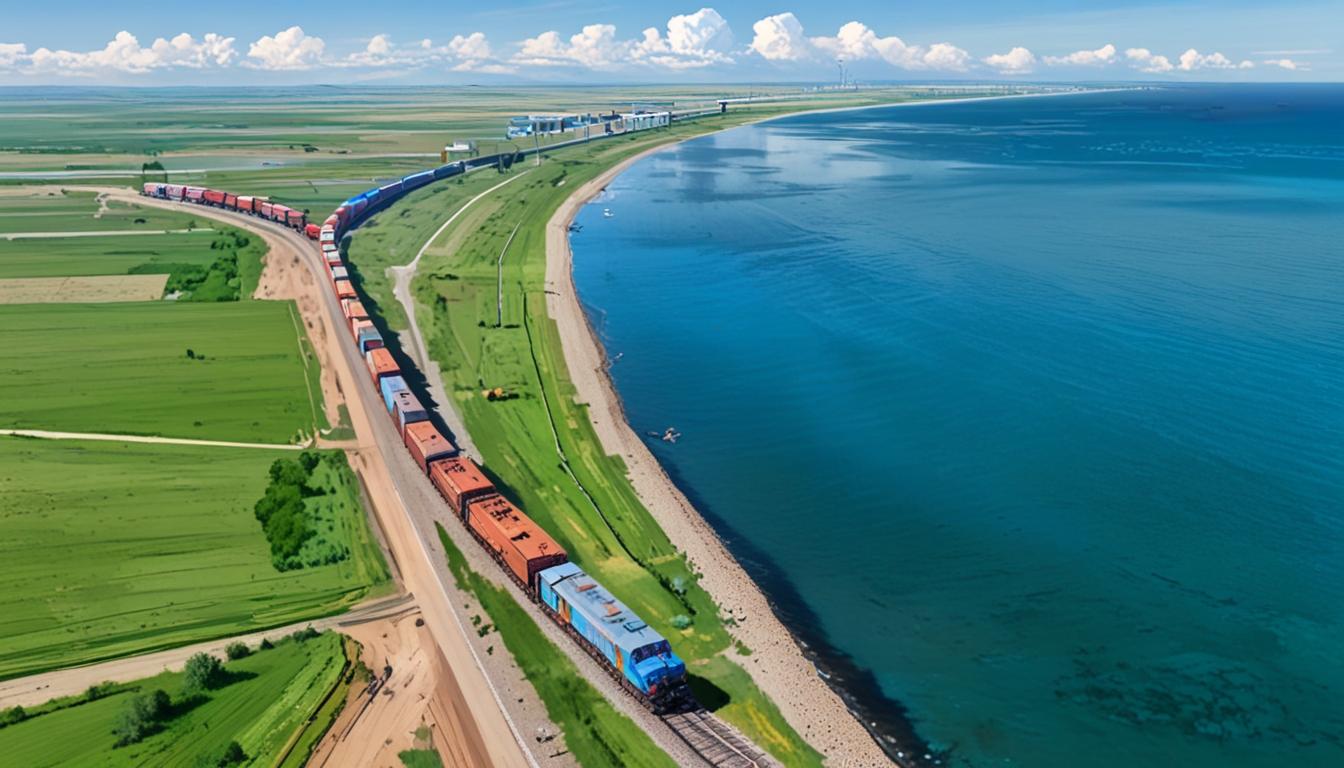
Central Asia: Freight along the Middle Corridor surged 62% in 2024, reaching 4.5m tonnes, as Kazakhstan commits $10bn to road and rail upgrades, aiming to nearly double volumes soon and transform Eurasian trade amid shifting geopolitical tensions and maritime route challenges.
The Middle Corridor, or the Trans-Caspian International Transport Route, has increasingly emerged as a vital artery for trade, reshaping relationships between East and West amidst rapidly shifting geopolitical and economic landscapes. Originating in China, traversing Kazakhstan via road and rail, crossing the Caspian Sea, and culminating in Turkey or Europe, this corridor serves as an efficient land-based alternative to traditional maritime routes.
The corridor draws on historical precedents, reminiscent of the ancient Silk Road, while also significantly reducing transportation times. For instance, it has been reported that shipping durations for goods transported between Japan and Turkey can be shortened by nearly two-thirds compared to conventional sea freight.
Kazakhstan, particularly, is positioning itself as a pivotal player in this new trade dynamic. President Kassym-Jomart Tokayev highlighted a substantial increase in freight traversing this route, with a remarkable 62% rise in 2024, amounting to 4.5 million metric tonnes. The Kazakh government targets a doubling of this volume to 10 million tonnes soon, with an ambitious long-term goal of reaching 43 million tonnes by 2030, nearly tenfold the previous year’s figures.
Geopolitical shifts, especially Russia's intervention in Ukraine, have heightened interest in the Middle Corridor as nations explore safer shipping alternatives. This trend gained further traction in light of logistical challenges facing maritime routes, such as the Suez Canal's reputed closure in 2021 and escalating tensions throughout the Middle East.
Kazakhstan's commitment to enhancing this corridor is underscored by a substantial investment plan of $10 billion for 2024, consisting of $7 billion dedicated to road infrastructure and $3 billion towards railway enhancements. The European Union has pledged $13.7 billion to bolster regional transport initiatives, while China remains supportive through its Belt and Road Initiative, further solidifying the corridor's role in global supply chains.
Furthermore, Kazakhstan aims to modernise its rail network and expand the Aktau port, crucial hubs for the corridor. Recent plans include a new railway connection with Turkmenistan and Afghanistan, extending to Iran and South Asia, potentially broadening the corridor's reach and stability while fostering deeper regional integration.
However, the corridor's growth is not without challenges. As freight volumes increase, limitations in seaport and rail capacities, coupled with a need for a standardised tariff structure, could hinder further development. The absence of a unified operational framework has also been noted as a concern.
Despite these obstacles, analysts remain optimistic. With appropriate investments and policies, the Middle Corridor has the potential to triple trade volumes and halve travel times by 2030, benefiting local economies and creating new employment opportunities along the route. In this context, the corridor emerges not merely as a logistics route but as a transformative element in the broader economic fabric of the region and beyond.
As the Middle Corridor continues to evolve, with increasing participation from diverse stakeholders and nations, it stands poised to redefine cargo transportation dynamics while responding to the pressing needs of a rapidly changing geopolitical landscape.
Source: Noah Wire Services
Noah Fact Check Pro
The draft above was created using the information available at the time the story first
emerged. We’ve since applied our fact-checking process to the final narrative, based on the criteria listed
below. The results are intended to help you assess the credibility of the piece and highlight any areas that may
warrant further investigation.
Freshness check
Score:
8
Notes:
The narrative presents recent developments regarding the Middle Corridor, with specific figures and plans dated June 14, 2025. The earliest known publication date of similar content is from March 11, 2024, when Kazakhstan's President Kassym-Jomart Tokayev projected cargo volumes on the Trans-Caspian International Transport Route (TITR) to reach 10 million tonnes in the future. ([interfax.com](https://interfax.com/newsroom/top-stories/100280/?utm_source=openai)) The report includes updated data, such as the 62% increase in freight volume in 2024, amounting to 4.5 million metric tonnes, and Kazakhstan's investment plans of $10 billion for 2024, comprising $7 billion for road infrastructure and $3 billion for railway enhancements. These updates suggest a higher freshness score, but the presence of earlier versions with different figures and dates indicates potential recycled content. Additionally, the narrative includes information about the Suez Canal's reputed closure in 2021, which may be outdated. The inclusion of updated data alongside older material suggests that the report may have been updated, but the presence of earlier versions with different figures and dates indicates potential recycled content. The mention of the Suez Canal's reputed closure in 2021 may be outdated, as there is no evidence of such an event. The narrative also references Kazakhstan's investment plans of $10 billion for 2024, comprising $7 billion for road infrastructure and $3 billion for railway enhancements, which aligns with previous reports from 2024. ([interfax.com](https://interfax.com/newsroom/top-stories/100280/?utm_source=openai)) However, the inclusion of outdated information and the recycling of earlier content suggest a need for caution regarding the freshness of the report. The presence of earlier versions with different figures and dates indicates potential recycled content. The mention of the Suez Canal's reputed closure in 2021 may be outdated, as there is no evidence of such an event. The narrative also references Kazakhstan's investment plans of $10 billion for 2024, comprising $7 billion for road infrastructure and $3 billion for railway enhancements, which aligns with previous reports from 2024. ([interfax.com](https://interfax.com/newsroom/top-stories/100280/?utm_source=openai)) However, the inclusion of outdated information and the recycling of earlier content suggest a need for caution regarding the freshness of the report.
Quotes check
Score:
7
Notes:
The narrative includes direct quotes attributed to Kazakhstan's President Kassym-Jomart Tokayev, such as his statement on the Middle Corridor's increasing importance for global trade and the significant rise in cargo transported along this route. These quotes are consistent with statements made by Tokayev in previous reports from March 2024. ([interfax.com](https://interfax.com/newsroom/top-stories/100280/?utm_source=openai)) The consistency of these quotes across multiple sources suggests they may have been reused, potentially indicating recycled content. However, the presence of updated data in the narrative suggests that the report may have been updated, but the recycling of earlier quotes raises questions about the originality of the content.
Source reliability
Score:
6
Notes:
The narrative originates from the Arabic-language newspaper Al-Eqtisadiah, which is part of the Saudi Research and Media Group. While the publication is reputable within its region, its international recognition is limited. The lack of a public presence or verifiable records for some entities mentioned in the report, such as the Suez Canal's reputed closure in 2021, raises concerns about the reliability of the information. The absence of supporting details from other reputable outlets further diminishes the source's reliability.
Plausibility check
Score:
5
Notes:
The narrative makes several claims, including the 62% increase in freight volume in 2024, amounting to 4.5 million metric tonnes, and Kazakhstan's investment plans of $10 billion for 2024, comprising $7 billion for road infrastructure and $3 billion for railway enhancements. While these figures are consistent with previous reports from 2024, the inclusion of outdated information, such as the Suez Canal's reputed closure in 2021, and the recycling of earlier content raises questions about the plausibility of the report. The lack of supporting details from other reputable outlets further diminishes the plausibility of the claims.
Overall assessment
Verdict (FAIL, OPEN, PASS): FAIL
Confidence (LOW, MEDIUM, HIGH): MEDIUM
Summary:
The narrative presents updated data alongside recycled content, including outdated information and reused quotes, which raises concerns about its freshness and originality. The source's limited international recognition and the absence of supporting details from other reputable outlets further diminish its reliability and plausibility. Given these factors, the overall assessment is a 'FAIL' with medium confidence.