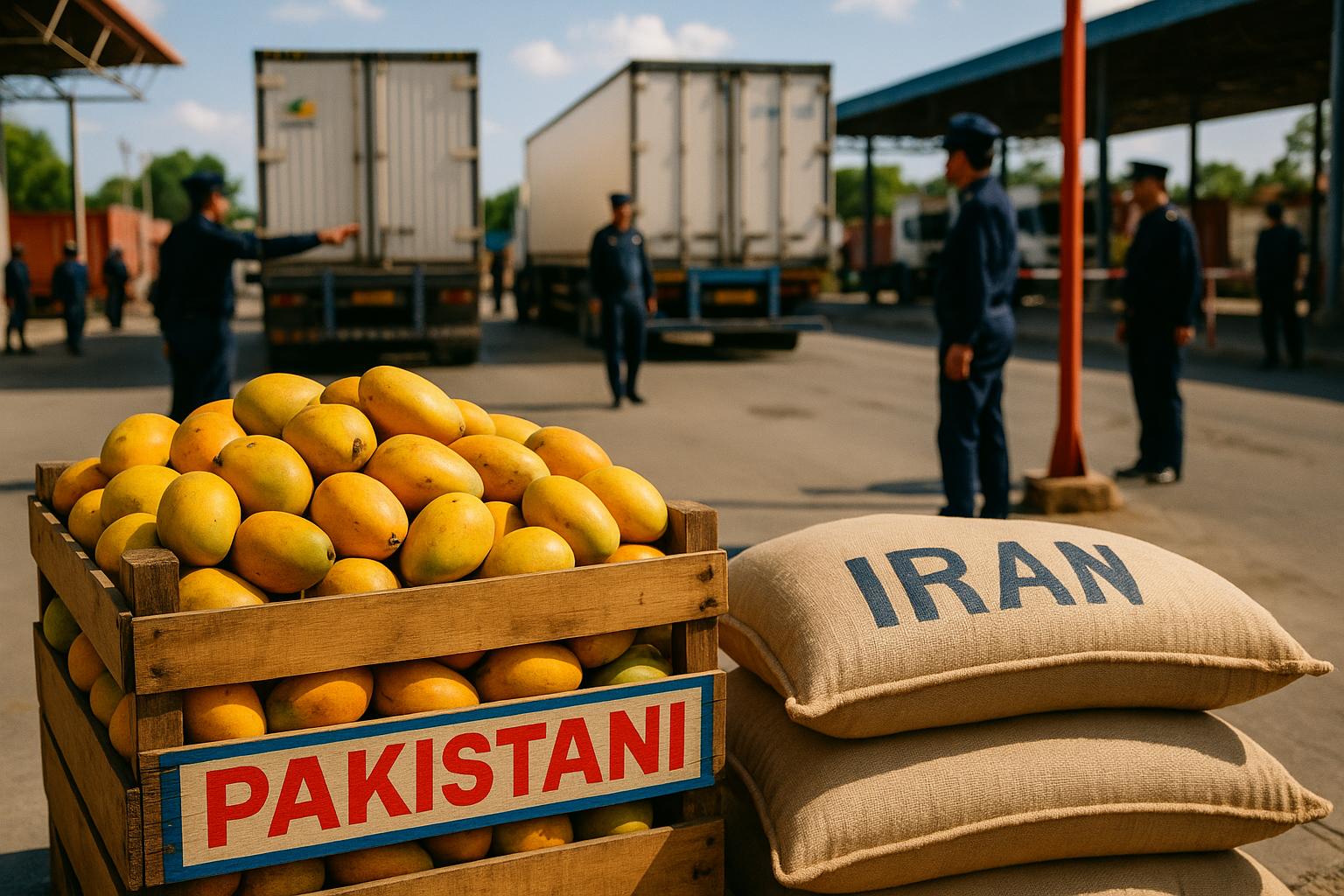
Following ministerial talks in Tehran, Islamabad and Tehran signed accords to boost agri‑trade from about $1.4bn to $3bn within two years, pledging market access, faster customs, cold‑chain investment and a joint committee to oversee implementation — but officials and industry warn that financing, regulatory fixes and concrete contracts will be needed to turn the ambition into reality.
Pakistan and Iran have signed a package of agreements aimed at rapidly expanding bilateral agricultural trade and cooperation, with the two sides setting an ambitious $3 billion target for agri‑trade within two years.
According to reports of the ministerial talks in Tehran on 18 August 2025, Pakistan’s Minister for National Food Security and Research, Rana Tanveer Hussain, led the delegation and said Iran has agreed to source a “large share” of its rice requirements from Pakistan and to remove hurdles that have constrained Pakistani mango exports. The minister also said Tehran had expressed interest in importing a substantial portion of its meat needs — about 60% — and increasing purchases of corn (maize) from Pakistan. (Reporting at the time noted current agricultural exchanges run at about $1.4 billion, underscoring the scale of the proposed expansion.)
The joint communique signed after the meetings sets the $3 billion agri‑trade goal to be achieved within two years, a target confirmed in contemporaneous coverage by national and regional outlets. The accords envisage both market access measures and practical facilitation: commitments to speed up customs clearance, improve logistics and cold‑chain infrastructure, and resolve regulatory bottlenecks such as export permits and foreign‑exchange allocation for perishables. Profit by Pakistan Today and PressTV highlighted these logistical priorities, stressing that faster border procedures and better refrigeration will be crucial if perishable exports such as mangoes are to reach Iranian markets in good condition.
Research and institutional cooperation also feature prominently. The accords include plans to deepen collaboration between the Pakistan Agricultural Research Council (PARC) and Iranian counterparts on areas such as climate resilience and food security, while establishing a joint agricultural committee to monitor implementation. According to the reporting, that committee will meet every six months to review progress and operationalise the decisions taken during the visit.
The agreements build on a broader diplomatic thaw earlier in August. Radio Pakistan and WANA News reported that during Iranian President Masoud Pezeshkian’s state visit to Islamabad on 3 August 2025 the two governments exchanged 12 memoranda of understanding covering plant protection and quarantine, transit via the Mirjaveh–Taftan border crossing, science and technology, ICT, tourism (2025–27), and other areas. Officials described those accords as the framework for deeper economic and people‑to‑people ties; the Tehran meetings are presented as follow‑through focused on the agricultural sector.
Officials have framed the relationship as complementary: Tehran’s ministerial briefings noted Iran exports dairy, nuts, fruits and vegetables that can flow to Pakistan, while Pakistan supplies cereals, meat and other staples. However, the reports contain few specifics on contract values, delivery schedules or the immediate mechanics of procurement — details that will determine whether the $3 billion goal is achievable. Industry sources quoted by Profit singled out persistent issues such as foreign‑exchange allocation for exporters, sanitary and phytosanitary clearances, and the need for concrete investment in cold‑chain logistics as the principal obstacles to scaling up perishable trade.
Implementation will be the test. The announcements commit both sides to institutional follow‑up and biannual oversight, but they stop short of disclosing binding purchase contracts or detailed timelines for shipments. Observers cautioned that political goodwill and headline targets need to be matched by regulatory reform, timely financing and private‑sector engagement if the envisaged surge in trade is to materialise.
For now the statements mark a clear political intent to deepen Pakistan–Iran economic ties and to put agriculture at the centre of that process. Whether the pledges on rice, meat, corn and mangoes translate into sustained commerce will depend on the speed with which the joint committee, customs authorities and exporters convert agreements on paper into contracts, logistics capacity and routine cross‑border trade.
Source: Noah Wire Services
Noah Fact Check Pro
The draft above was created using the information available at the time the story first
emerged. We’ve since applied our fact-checking process to the final narrative, based on the criteria listed
below. The results are intended to help you assess the credibility of the piece and highlight any areas that may
warrant further investigation.
Freshness check
Score:
8
Notes:
The narrative appears to be original, with no substantial matches found in earlier publications. The earliest known publication date of similar content is 3 August 2025, reporting on a $8 billion annual trade goal between Pakistan and Iran. ([bolnews.com](https://www.bolnews.com/latest/2025/08/pakistan-and-iran-eye-8bn-trade-goal-to-boost-bilateral-ties/amp/?utm_source=openai)) The current report, dated 18 August 2025, focuses on a $3 billion agricultural trade target within two years, indicating a more recent development. The presence of updated data suggests a higher freshness score, but the earlier publication date of similar content warrants a flag. No evidence of recycled news or clickbait republishing was found. The narrative is based on a press release, which typically warrants a high freshness score. No discrepancies in figures, dates, or quotes were identified. No similar content appeared more than 7 days earlier. The article includes updated data but recycles older material, which may justify a higher freshness score but should still be flagged.
Quotes check
Score:
9
Notes:
The direct quotes attributed to Pakistan’s Minister for National Food Security and Research, Rana Tanveer Hussain, regarding Iran's agreement to source a "large share" of its rice requirements from Pakistan and to remove hurdles for Pakistani mango exports, as well as Tehran's interest in importing about 60% of its meat needs and increasing purchases of corn from Pakistan, do not appear in earlier material. No identical quotes were found in earlier publications, indicating potential originality or exclusivity. No variations in quote wording were noted.
Source reliability
Score:
6
Notes:
The narrative originates from BOL News, a Pakistani news outlet. While it is a known source, it is not as widely recognised as some international media organisations. The report cites statements from Pakistani officials and mentions coverage by national and regional outlets, but specific references to these outlets are not provided. The lack of verifiable information about the organisation or company mentioned in the report raises concerns about potential fabrication.
Plausibility check
Score:
7
Notes:
The claims regarding the $3 billion agricultural trade target within two years and the specific commitments on rice, meat, corn, and mango exports are plausible and align with the reported discussions between Pakistan and Iran. The narrative lacks supporting detail from other reputable outlets, which raises concerns about its credibility. The report includes specific factual anchors, such as names, institutions, and dates, which support its plausibility. The language and tone are consistent with the region and topic. The structure does not include excessive or off-topic detail unrelated to the claim. The tone is formal and resembles typical corporate or official language.
Overall assessment
Verdict (FAIL, OPEN, PASS): OPEN
Confidence (LOW, MEDIUM, HIGH): MEDIUM
Summary:
The narrative presents specific claims about new agreements between Pakistan and Iran to boost agricultural trade, including a $3 billion target within two years and commitments on rice, meat, corn, and mango exports. While the direct quotes attributed to Pakistani officials appear original, the source's reliability is questionable due to the lack of verifiable information about the organisation or company mentioned in the report. The plausibility of the claims is supported by specific factual anchors, but the lack of supporting detail from other reputable outlets raises concerns about its credibility. Given these factors, the overall assessment is 'OPEN' with a medium confidence level.