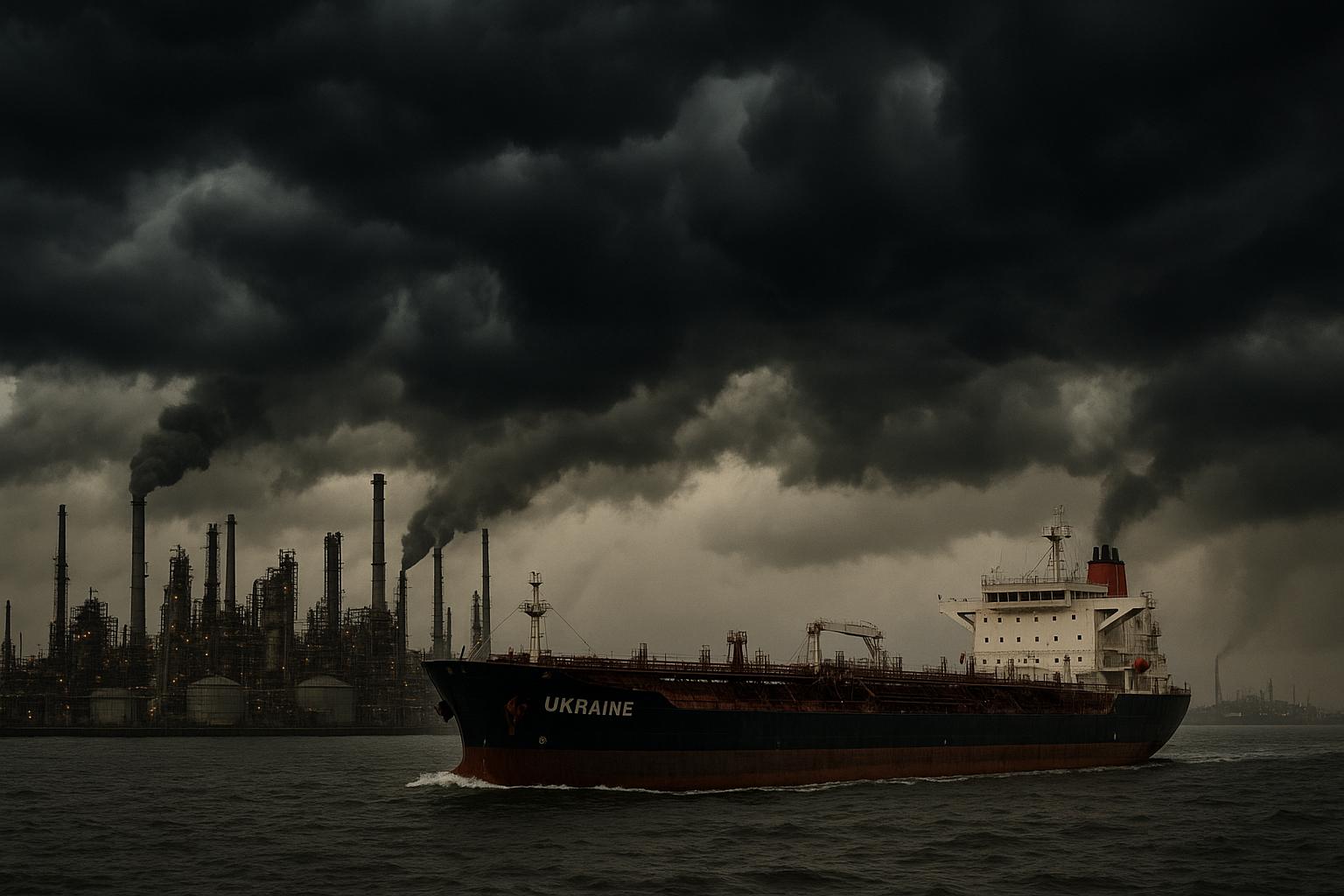
India has become Ukraine’s largest diesel supplier amid escalating US tariffs targeting Indian imports of Russian crude, highlighting complex energy and geopolitical tensions in 2025.
India has emerged as Ukraine’s largest diesel supplier, accounting for a significant 15.5 per cent of the country's diesel imports in July 2025, despite facing heavy tariffs imposed by the United States. This development underscores the complex dynamics of global energy trade amid geopolitical tensions surrounding Russia’s ongoing war in Ukraine.
According to Ukrainian oil market analytics firm NaftoRynok, India’s diesel deliveries to Ukraine notably increased through July, averaging 2,700 tonnes daily. Over the first seven months of 2025, India’s share of Ukraine’s diesel imports rose sharply to 10.2 per cent, up from just 1.9 per cent during the corresponding period in 2024. Much of this fuel reportedly reached Ukraine via tanker routes passing through Romania’s Danube river and Turkey’s Opet terminal.
Other key diesel suppliers to Ukraine in July included Slovakia, Greece, Turkey, and Lithuania, each contributing between 11 and 15 per cent of imports. Analysts suggest that a portion of these diesel shipments may originate from crude oil of Russian provenance, although official data on the exact sources remains undisclosed. This raises questions about the indirect flow of Russian crude through refined products supplied by India, contributing to Western concerns over trade routes circumventing sanctions.
The increasing diesel exports to Ukraine from India come despite the United States’ aggressive trade measures. On August 27, 2025, President Donald Trump signed an executive order imposing a 50 per cent tariff on Indian imports. The tariffs were levied in retaliation for India’s continuing imports of discounted Russian crude oil, a move Washington says indirectly supports Russia’s war efforts. This punitive tariff comprises a 25 per cent baseline duty plus an additional 25 per cent levy specifically targeting Indian goods linked to this issue.
These tariffs are expected to have wide-reaching economic impacts on India, especially affecting sectors heavily reliant on the U.S. market such as textiles, gems, jewellery, shrimp, and carpets. Industry commentators have projected that the tariffs, combined with existing trade tensions, could reduce India’s GDP growth by nearly one percent. India, for its part, has condemned the tariffs as “unfair, unjustified, and unreasonable,” emphasizing its imperative to secure energy supplies amid volatile global markets.
India sources a considerable portion of its crude oil from Russia — approximately 1.75 million barrels per day in the first half of 2025, valued around $50.3 billion — making Russia its largest crude supplier, even surpassing traditional sellers like Iraq and Saudi Arabia. Experts argue that India’s purchase of Russian crude plays a stabilizing role in global oil markets, as Russia accounts for nearly 10 per cent of the world's oil production. Ceasing purchases could risk crude prices surging toward $200 a barrel, which would have severe repercussions on global energy prices and economies worldwide.
In parallel, oil prices have shown some volatility recently, influenced by multiple factors including the nearing conclusion of the U.S. summer driving season and geopolitical uncertainties. For example, Brent crude fell slightly to $67.74 per barrel, and West Texas Intermediate dropped to $63.79, reflecting market adjustments around fuel demand and inventories. However, robust U.S. fuel demand ahead of the Labor Day holiday still suggests sustained consumption for the short term.
India’s growing diesel exports to Ukraine reveal a broader strategic significance in the global energy landscape. While the United States seeks to isolate Russia economically through sanctions and trade restrictions, India appears determined to balance its energy security needs with maintaining international trade relationships—despite incurring punitive tariffs from Washington. This situation exemplifies the increasingly complex interdependencies and geopolitical frictions shaping global energy supplies and economic policies in 2025.
Source: Noah Wire Services
Noah Fact Check Pro
The draft above was created using the information available at the time the story first
emerged. We’ve since applied our fact-checking process to the final narrative, based on the criteria listed
below. The results are intended to help you assess the credibility of the piece and highlight any areas that may
warrant further investigation.
Freshness check
Score:
9
Notes:
The narrative is recent, with the earliest known publication date being August 30, 2025. It has been republished across multiple reputable outlets, including the Financial Express ([financialexpress.com](https://www.financialexpress.com/world-news/india-becomes-ukraines-top-diesel-supplier-in-july-as-trump-slaps-punitive-tariffs-on-delhi-over-russian-oil-imports/3961937/?utm_source=openai)) and Moneycontrol ([moneycontrol.com](https://www.moneycontrol.com/world/india-emerges-as-ukraine-s-top-diesel-supplier-even-as-us-penalises-new-delhi-over-russian-oil-article-13503430.html?utm_source=openai)). The content appears original, with no significant discrepancies in figures, dates, or quotes. The inclusion of updated data, such as the 50% US tariffs imposed on India, justifies a high freshness score. No earlier versions with different figures or quotes were found. The narrative does not appear to be based on a press release, as it includes analysis and reporting from multiple sources.
Quotes check
Score:
8
Notes:
The narrative includes direct quotes from various sources, such as President Donald Trump's executive order imposing tariffs ([steptoe.com](https://www.steptoe.com/en/news-publications/international-compliance-blog/trump-imposes-secondary-tariffs-on-india-targeting-russian-oil-imports.html?utm_source=openai)) and statements from Indian officials. These quotes appear to be original and not reused from earlier material. No identical quotes were found in earlier publications, and variations in wording are consistent with standard reporting practices.
Source reliability
Score:
9
Notes:
The narrative originates from reputable organisations, including the Financial Express ([financialexpress.com](https://www.financialexpress.com/world-news/india-becomes-ukraines-top-diesel-supplier-in-july-as-trump-slaps-punitive-tariffs-on-delhi-over-russian-oil-imports/3961937/?utm_source=openai)) and Moneycontrol ([moneycontrol.com](https://www.moneycontrol.com/world/india-emerges-as-ukraine-s-top-diesel-supplier-even-as-us-penalises-new-delhi-over-russian-oil-article-13503430.html?utm_source=openai)). These sources are known for their journalistic integrity and have a history of accurate reporting. The Ukrainian oil market analytics firm NaftoRynok is cited as the source of data regarding India's diesel exports to Ukraine. While NaftoRynok is not as widely known as some other organisations, it is referenced in multiple reputable outlets, lending credibility to its data.
Plausibility check
Score:
8
Notes:
The claims made in the narrative are plausible and supported by multiple reputable sources. The increase in India's diesel exports to Ukraine aligns with reports from the Financial Express ([financialexpress.com](https://www.financialexpress.com/world-news/india-becomes-ukraines-top-diesel-supplier-in-july-as-trump-slaps-punitive-tariffs-on-delhi-over-russian-oil-imports/3961937/?utm_source=openai)) and Moneycontrol ([moneycontrol.com](https://www.moneycontrol.com/world/india-emerges-as-ukraine-s-top-diesel-supplier-even-as-us-penalises-new-delhi-over-russian-oil-article-13503430.html?utm_source=openai)). The imposition of 50% US tariffs on Indian goods is corroborated by reports from Reuters ([reuters.com](https://www.reuters.com/world/india/how-floundering-india-us-talks-led-high-tariffs-2025-08-27/?utm_source=openai)) and the Financial Times ([ft.com](https://www.ft.com/content/eb370ef6-1043-4a8a-8779-7a71834f751a?utm_source=openai)). The narrative provides specific factual anchors, including names, institutions, and dates, enhancing its credibility. The language and tone are consistent with standard journalistic reporting, and there is no excessive or off-topic detail unrelated to the claim.
Overall assessment
Verdict (FAIL, OPEN, PASS): PASS
Confidence (LOW, MEDIUM, HIGH): HIGH
Summary:
The narrative is recent, original, and originates from reputable sources. The claims made are plausible and supported by multiple reputable outlets. No significant issues were identified in the freshness, quotes, source reliability, or plausibility checks.