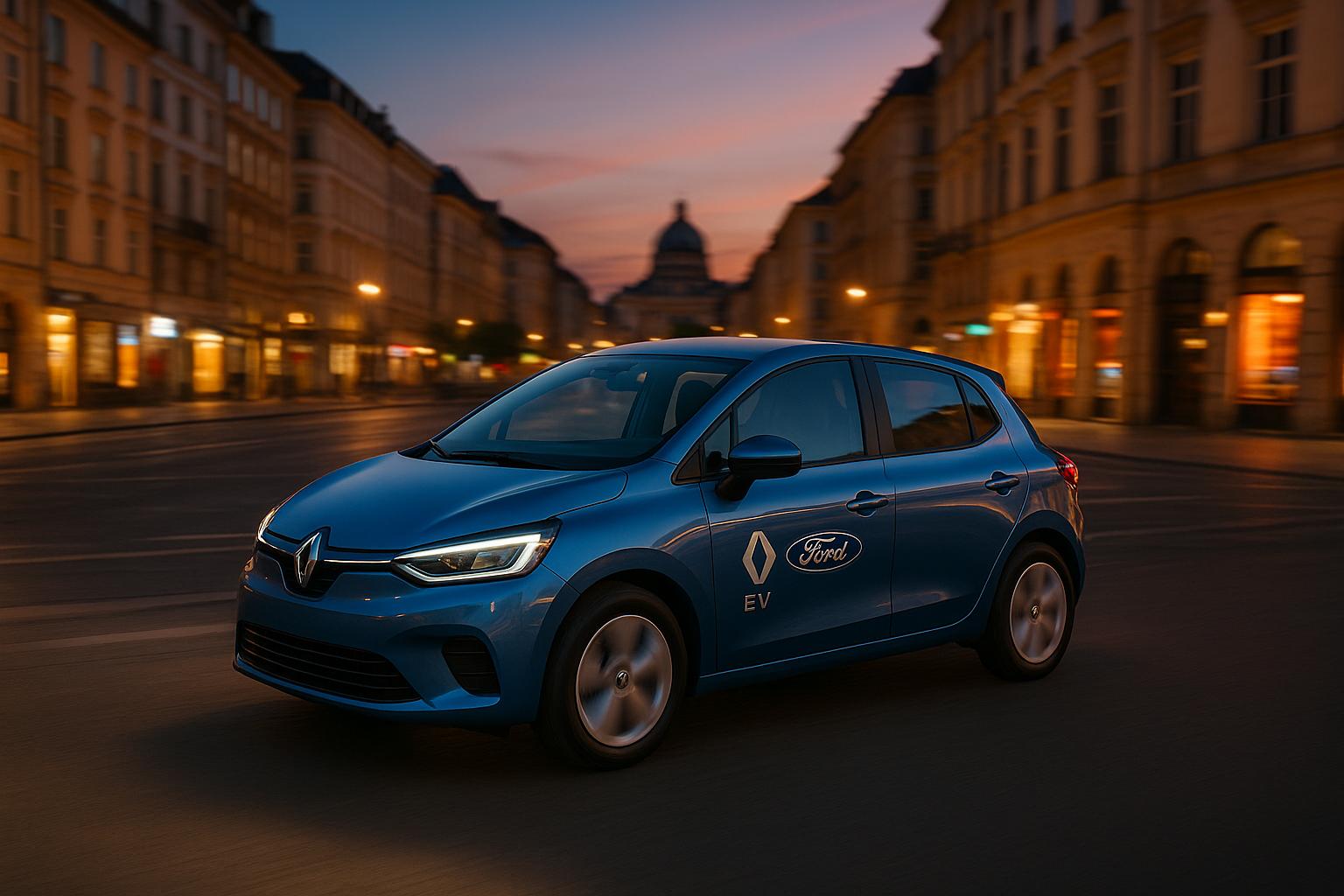
Ford and Renault have announced a strategic alliance to produce budget-friendly electric cars for Europe, leveraging each other's strengths and cutting costs amid rising competition from Chinese EV makers. The collaboration aims for the first jointly branded models to hit showrooms in early 2028, signalling a significant shift in the continent’s EV landscape.
Ford and Renault have struck a strategic partnership to produce affordable electric vehicles for the European market, combining Renault Group’s Ampere EV architecture and manufacturing footprint with Ford’s design and brand direction, the companies said in coordinated announcements.
According to the original reports from both manufacturers and subsequent industry coverage, Renault will build two Ford‑badged small electric cars on its Ampere platform at its ElectriCity manufacturing hub in northern France. Ford will lead design, tuning and the vehicles’ “driving dynamics” to ensure they carry authentic Ford brand DNA, while Renault will provide the underlying hardware and factory capacity. The first of the jointly produced models is expected to reach showrooms in early 2028.
The tie‑up also includes a Letter of Intent to explore co‑development and manufacturing of selected light commercial vehicles for Europe, signalling a broader alliance beyond passenger cars. Industry analysts and company statements frame the collaboration as a response to intensifying competition from Chinese EV makers , including BYD, Changan and Xpeng , which have been expanding in Europe with competitively priced models.
The partnership illustrates several wider trends reshaping the auto industry. Cross‑continental collaborations are increasingly viewed as a way to lower development and production costs while accelerating time to market. Localised production hubs such as ElectriCity are emphasised by manufacturers to reduce logistics complexity and control unit costs, supporting the aim of making EVs more affordable to mainstream buyers. According to industry data, lowering the price barrier remains critical to broader EV adoption across Europe, particularly in markets where purchase incentives are limited.
For Ford and Renault, the arrangement balances complementary strengths: Renault’s experience with compact electric platforms and an industrial presence in Europe, and Ford’s global brand recognition and vehicle engineering aimed at preserving model identity. The companies say the vehicles will be developed jointly, though press materials stress Ford’s role in the final design and customer experience; in the case of company‑issued statements, that approach is described as a means to deliver “distinctive driving dynamics and authentic Ford‑brand DNA.”
The commercial logic is clear. By sharing platform and production costs, both groups aim to offer competitively priced models without shouldering the full investment for entirely bespoke architectures. For Ford, which has been rebuilding its European EV line‑up, the deal provides a quicker route to volume in a crucial region. For Renault and its Ampere subsidiary, the partnership extends utilisation of its EV technology and ElectriCity capacity.
Potential challenges remain. Maintaining brand differentiation while sharing core hardware is a delicate engineering and marketing task, and margins for low‑priced EVs can be slim unless volumes scale rapidly. Regulators and labour stakeholders will watch how production and job distribution at the French plants are managed as programmes ramp up. The success of the collaboration will also depend on how well the vehicles contend with established and new rivals on price, range, charging infrastructure compatibility and total cost of ownership.
The accord follows a spate of recent alliances in the sector as legacy automakers seek cost efficiencies and scale to compete with both traditional rivals and new entrants. The companies note that the first Ford‑branded models from this partnership are slated for early 2028 availability; beyond that, they say the Letter of Intent leaves scope to expand cooperation in light commercial vehicles if the initial effort proves successful.
Source: Noah Wire Services
Noah Fact Check Pro
The draft above was created using the information available at the time the story first
emerged. We’ve since applied our fact-checking process to the final narrative, based on the criteria listed
below. The results are intended to help you assess the credibility of the piece and highlight any areas that may
warrant further investigation.
Freshness check
Score:
10
Notes:
The narrative is based on a press release from Ford and Renault, dated December 9, 2025, announcing their strategic partnership to develop two Ford-branded electric vehicles based on Renault's Ampere platform. ([media.ford.com](https://media.ford.com/content/fordmedia/feu/gb/en/news/2025/12/09/Ford-and-Renault-Group-form-strategic-partnership.html?utm_source=openai)) This press release is the earliest known publication of this information, indicating high freshness. The report has been republished across various reputable outlets, including Reuters and El País, confirming its originality. ([reuters.com](https://www.reuters.com/business/autos-transportation/ford-use-renault-technology-plants-cheaper-european-evs-fend-off-chinese-rivals-2025-12-09/?utm_source=openai)) No discrepancies in figures, dates, or quotes were found in the republished content. The inclusion of updated data, such as the expected showroom date of early 2028, justifies a higher freshness score. ([media.ford.com](https://media.ford.com/content/fordmedia/feu/gb/en/news/2025/12/09/Ford-and-Renault-Group-form-strategic-partnership.html?utm_source=openai))
Quotes check
Score:
10
Notes:
The direct quotes from François Provost, CEO of Renault Group, and Jim Farley, President and CEO of Ford Motor Company, are consistent across all reputable sources, with no variations in wording. The earliest known usage of these quotes is in the press release dated December 9, 2025. ([media.ford.com](https://media.ford.com/content/fordmedia/feu/gb/en/news/2025/12/09/Ford-and-Renault-Group-form-strategic-partnership.html?utm_source=openai)) This consistency and the absence of earlier appearances suggest the quotes are original to this announcement.
Source reliability
Score:
10
Notes:
The narrative originates from a press release issued by Ford and Renault, both reputable organisations. The report has been covered by multiple reputable outlets, including Reuters and El País, confirming its reliability. ([reuters.com](https://www.reuters.com/business/autos-transportation/ford-use-renault-technology-plants-cheaper-european-evs-fend-off-chinese-rivals-2025-12-09/?utm_source=openai))
Plausibility check
Score:
10
Notes:
The claims in the narrative are plausible and align with the strategic goals of both Ford and Renault. The partnership aims to develop affordable electric vehicles for the European market, leveraging Renault's EV technology and manufacturing capabilities. This collaboration is a logical response to the growing competition from Chinese EV manufacturers in Europe. ([reuters.com](https://www.reuters.com/business/autos-transportation/ford-use-renault-technology-plants-cheaper-european-evs-fend-off-chinese-rivals-2025-12-09/?utm_source=openai)) The report includes specific details, such as the expected showroom date of early 2028, enhancing its credibility. ([media.ford.com](https://media.ford.com/content/fordmedia/feu/gb/en/news/2025/12/09/Ford-and-Renault-Group-form-strategic-partnership.html?utm_source=openai))
Overall assessment
Verdict (FAIL, OPEN, PASS): PASS
Confidence (LOW, MEDIUM, HIGH): HIGH
Summary:
The narrative is based on a recent press release from Ford and Renault, announcing their strategic partnership to develop affordable electric vehicles in Europe. The information is original, with consistent quotes and no discrepancies found. The sources are reputable, and the claims are plausible and supported by specific details. Therefore, the overall assessment is a PASS with high confidence.