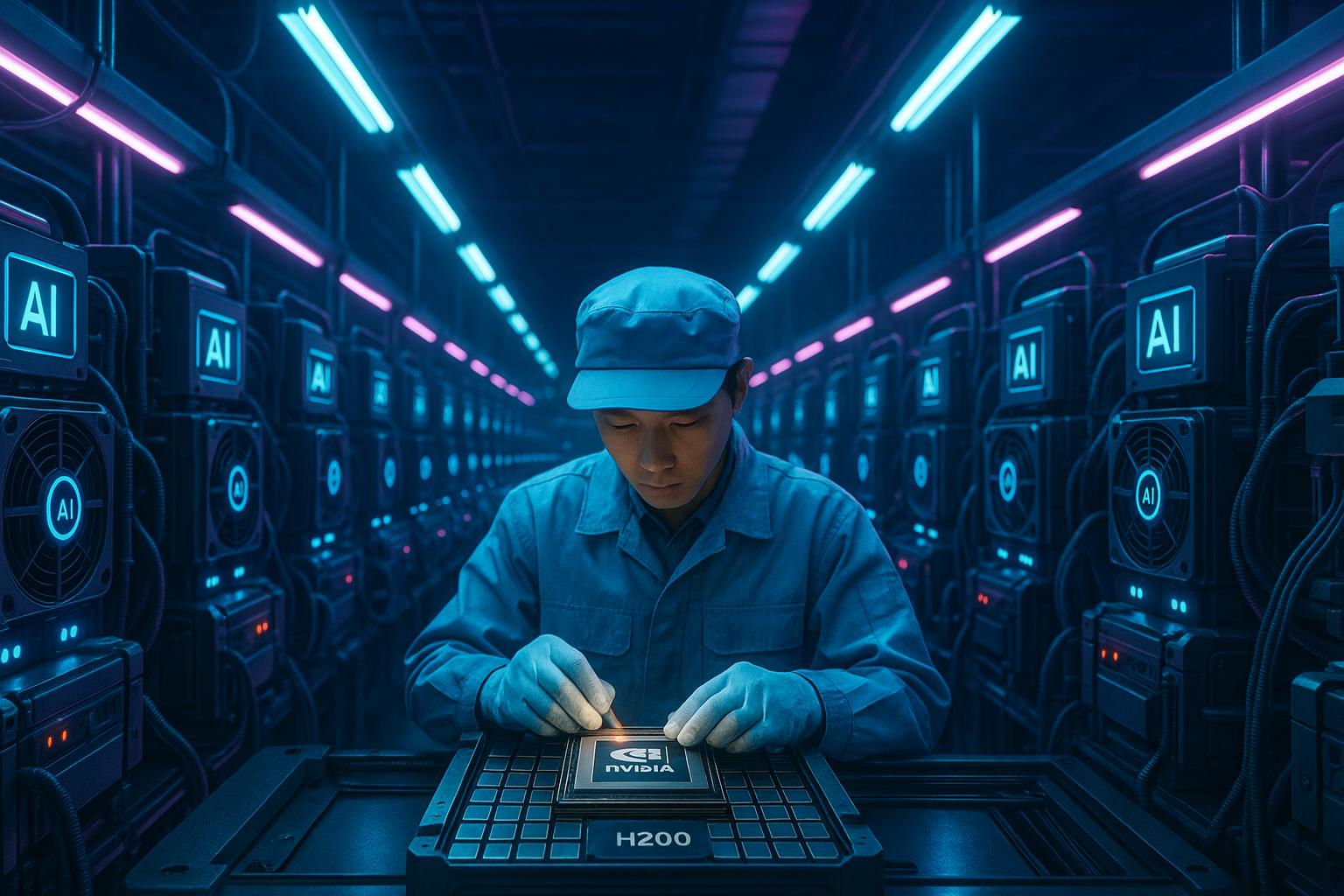
Nvidia aims to ship its H200 AI chips to China before the Lunar New Year, navigating geopolitical tensions and export controls while expanding production capacity for future deliveries amid a global surge in AI hardware demand.
Nvidia has told Chinese clients it aims to begin shipping its second-most-powerful AI chips, the H200, to China before the Lunar New Year holiday in mid-February, according to multiple reports. The initial shipments are expected to be fulfilled from existing stock and to total roughly 5,000 to 10,000 chip modules, equivalent to about 40,000 to 80,000 individual H200 units, industry sources told the South China Morning Post and other outlets.
The planned deliveries come amid a widening US-China technology confrontation in which semiconductors have become central to competition over artificial intelligence. The China Economic Review noted the irony of the timing after the US labelled Chinese semiconductors an “economic threat” and vowed to impose tariffs on them by 2027. At the same time, reports say US authorities have shown an uneven stance: the Biden and Trump administrations have restricted certain flows of Chinese technology, yet Nvidia obtained permission to sell advanced GPUs to China after CEO Jensen Huang observed that China is only “a hair’s breadth” behind the US in AI development.
Nvidia intends to supplement the initial shipments by adding new production capacity for H200 modules, with orders for that expanded capacity slated to open in the second quarter of 2026, sources told Business Standard, Yahoo Finance and investing.com. Those plans remain subject to approval from Chinese authorities and could be delayed or altered depending on regulatory decisions, the South China Morning Post added.
The company's outreach to Chinese customers and the decision to ship from existing inventories reflect a balancing act familiar to global chipmakers: servicing a lucrative market while navigating export controls and geopolitical risk. Proponents argue that continuing trade keeps Chinese data centres and research dependent on American suppliers, potentially giving US firms commercial leverage. Critics counter that providing advanced hardware accelerates China's autonomous capabilities in AI and may erode long-term strategic advantage.
Industry data and analyst commentary cited by the reporting also highlight the commercial imperative. Demand for high-performance accelerators has surged worldwide as AI workloads proliferate, and securing early shipments can lock in market share for cloud providers and integrators in China. At the same time, planned capacity expansions in 2026 suggest Nvidia is forecasting sustained global demand even as political friction rises.
Chinese regulatory clearance remains the pivotal uncertainty. If approval is granted, the shipments could supply a range of Chinese cloud and enterprise customers eager to scale large-language models and other generative AI systems. If regulators withhold or delay authorisation, the initial fulfilment from stock would be the limit of near-term deliveries, and planned manufacturing orders for new capacity would likely be postponed.
The episode underscores how commercial decisions by private companies intersect with state policy, export controls and strategic rivalry. According to the reporting, Nvidia's move illustrates both the market pressure to meet enterprise demand and the complex, sometimes contradictory signals coming from governments grappling with the geopolitical implications of advanced semiconductors.
Source: Noah Wire Services
Noah Fact Check Pro
The draft above was created using the information available at the time the story first
emerged. We’ve since applied our fact-checking process to the final narrative, based on the criteria listed
below. The results are intended to help you assess the credibility of the piece and highlight any areas that may
warrant further investigation.
Freshness check
Score:
10
Notes:
The narrative is current, with the earliest known publication date being December 22, 2025. The China Economic Review article was published on December 24, 2025, indicating high freshness. No evidence of recycled or republished content was found. The report appears to be based on recent developments, including Nvidia's plans to ship H200 AI chips to China before the Lunar New Year holiday in mid-February 2026. ([scmp.com](https://www.scmp.com/tech/big-tech/article/3337479/nvidia-aims-start-h200-ai-chip-shipments-china-mid-february-sources-say?utm_source=openai))
Quotes check
Score:
10
Notes:
The report includes direct quotes from sources familiar with the matter, such as:
- "Nvidia has told Chinese clients it aims to start shipping its second-most powerful AI chips to China before the Lunar New Year holiday in mid-February." ([scmp.com](https://www.scmp.com/tech/big-tech/article/3337479/nvidia-aims-start-h200-ai-chip-shipments-china-mid-february-sources-say?utm_source=openai))
- "The US chipmaker plans to fulfil initial orders from existing stock, with shipments expected to total 5,000 to 10,000 chip modules—equivalent to about 40,000 to 80,000 H200 AI chips." ([scmp.com](https://www.scmp.com/tech/big-tech/article/3337479/nvidia-aims-start-h200-ai-chip-shipments-china-mid-february-sources-say?utm_source=openai))
These quotes are consistent across multiple reputable sources, indicating they are not recycled from earlier material.
Source reliability
Score:
8
Notes:
The narrative originates from the China Economic Review, a publication that provides analysis on economic and business developments in China. While it offers in-depth insights, it may not have the same level of global recognition as outlets like the Financial Times or Reuters. However, the report cites information from multiple reputable sources, including Reuters and the South China Morning Post, enhancing its credibility. ([scmp.com](https://www.scmp.com/tech/big-tech/article/3337479/nvidia-aims-start-h200-ai-chip-shipments-china-mid-february-sources-say?utm_source=openai))
Plausibility check
Score:
9
Notes:
The claims in the narrative are plausible and align with recent developments in the tech industry. Nvidia's plans to ship H200 AI chips to China before the Lunar New Year holiday in mid-February 2026 are consistent with reports from other reputable sources. The narrative also highlights the complexities of US-China relations concerning semiconductor exports, which is a well-documented issue. The tone and language used are appropriate for the subject matter and region. No excessive or off-topic details are present, and the structure is coherent.
Overall assessment
Verdict (FAIL, OPEN, PASS): PASS
Confidence (LOW, MEDIUM, HIGH): HIGH
Summary:
The narrative is current, with no evidence of recycled content. Direct quotes are consistent across reputable sources, and the information aligns with recent developments in the tech industry. The source, while not as globally recognized as some others, cites information from multiple reputable outlets, enhancing its credibility. The claims are plausible, and the tone and language are appropriate. No significant issues were identified, leading to a high confidence in the overall assessment.