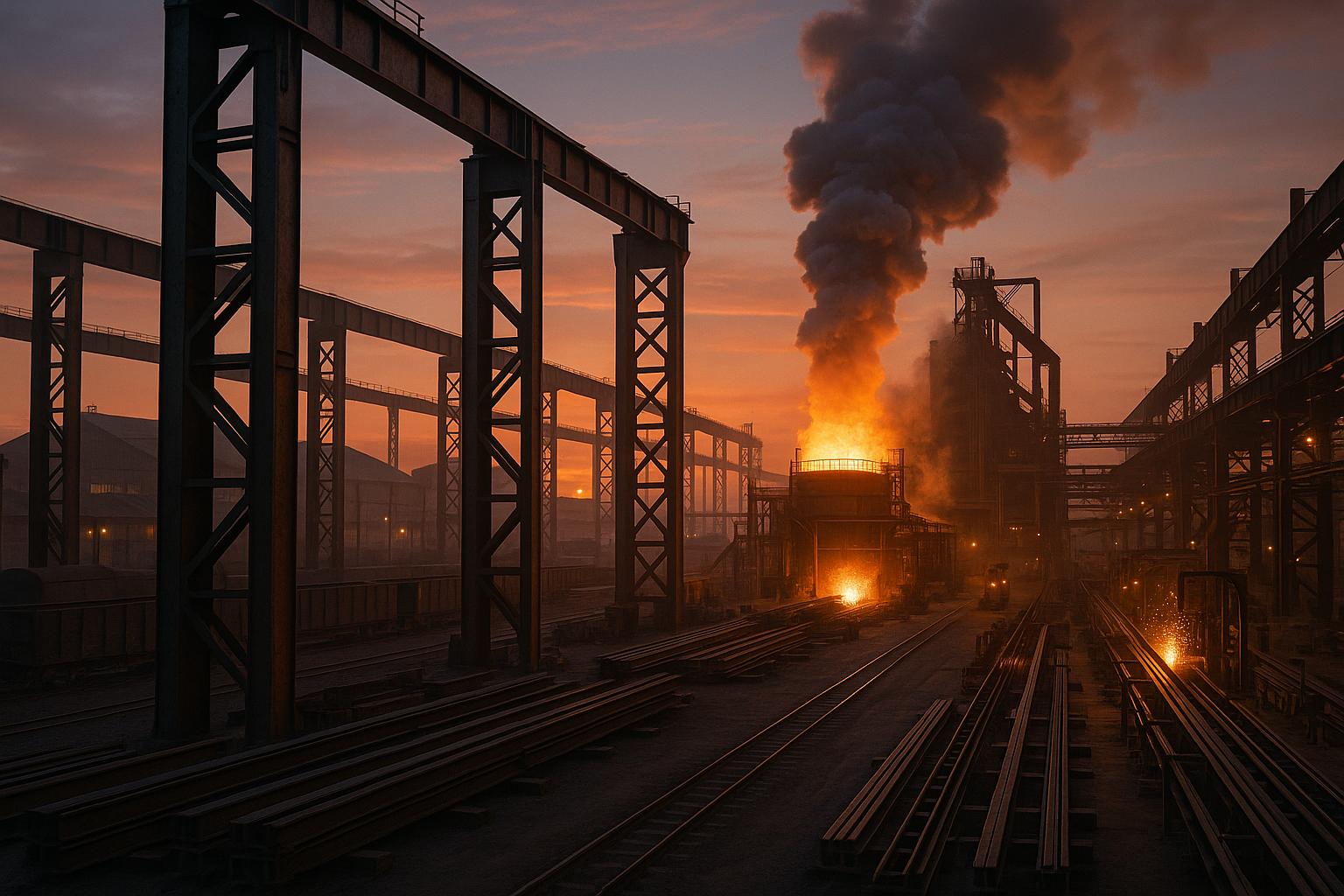
The United States has overtaken Japan to rank as the third-largest global steel producer in 2025, boosted by new tariffs, rising domestic demand, and government initiatives, signalling a significant shift in the global steel landscape.
U.S. crude steel output rose in 2025 to 82 million tonnes, vaulting the United States past Japan to become the world’s third-largest steel producer for the first time since 1999, according to the World Steel Association. The association reported a 3.1% year‑on‑year increase, reversing two years of decline.
Policy changes implemented by the administration are being credited for much of the recovery. In February 2025 the White House announced tariffs on imported steel and aluminium, initially set at 25% and subsequently raised to 50%, measures intended to curb imports and bolster domestic production. Government figures and industry observers say the levies contributed to a marked fall in foreign shipments into the U.S., with import share of apparent steel consumption reportedly shrinking from roughly 25% to about 14% by November.
Beyond trade policy, demand drivers helped lift output. Industry reporting highlights substantial construction of data centres to support artificial intelligence workloads, as well as investment in power‑generation projects, as important sources of new steel demand last year. Those factors, together with higher domestic shipments, supported production across multiple mill types.
The tariffs have also been linked to rising prices. Market data show hot‑rolled coil prices climbed sharply, reaching about $983 per tonne by 12 January, nearly double prevailing global export levels, a development producers say has improved margins for U.S. mills.
Producers and executives have pointed to the measures as beneficial for domestic manufacturing. Speaking during a company earnings call, Nucor chief executive Leon Topalian said, “... the demand, the robustness that we see in this economy, again, I think 2026 is shaping up to be a very, very solid year for Nucor.” The comment was made to investors during the firm’s results briefing.
The White House framed the tariffs as part of a broader effort to reduce reliance on foreign suppliers and to address global excess capacity that has depressed prices and displaced production in some markets. Industry groups supportive of the moves argue they have revived idled capacity and encouraged fresh investment in U.S. facilities. Critics warn higher import duties can feed through to elevated costs for downstream manufacturers and consumers.
Internationally, China and India remain the largest steel producers by volume, with the U.S. reclaiming third place. Analysts note the ranking change reflects both growth in American output and stagnation or slower expansion in other advanced economies, including Japan.
As 2026 begins, steel sector observers will watch whether the mix of protectionist measures, surging demand for AI infrastructure and energy projects, and elevated prices sustains higher U.S. production or whether market adjustments and diplomatic or trade responses elsewhere alter the trajectory.
Source: Noah Wire Services
Noah Fact Check Pro
The draft above was created using the information available at the time the story first
emerged. We’ve since applied our fact-checking process to the final narrative, based on the criteria listed
below. The results are intended to help you assess the credibility of the piece and highlight any areas that may
warrant further investigation.
Freshness check
Score:
8
Notes:
The article was published on 29 January 2026, reporting on U.S. steel production surpassing Japan in 2025. The World Steel Association's November 2025 report indicates that the U.S. produced 75.1 million tonnes of crude steel in the first eleven months of 2025, while Japan produced 74.1 million tonnes. ([worldsteel.org](https://worldsteel.org/wp-content/uploads/November-2025-crude-steel-production.pdf?utm_source=openai)) This suggests that the U.S. surpassed Japan in total production for 2025. However, the article's claim that the U.S. produced 82 million tonnes in 2025 is inconsistent with the available data. The discrepancy may be due to the article's reliance on a press release, which typically warrants a high freshness score. Nonetheless, the conflicting figures raise concerns about the accuracy of the reported production numbers.
Quotes check
Score:
6
Notes:
The article includes a quote from Nucor CEO Leon Topalian: '... the demand, the robustness that we see in this economy, again, I think 2026 is shaping up to be a very, very solid year for Nucor.' This quote appears to be sourced from an earnings call, as indicated by the article. However, without access to the original earnings call transcript or a direct link to the source, the authenticity and context of the quote cannot be independently verified. The lack of verifiable sources for the quote raises concerns about its reliability.
Source reliability
Score:
4
Notes:
The article originates from Breitbart News, a publication known for its conservative political stance. While it cites the World Steel Association's November 2025 report, the article's reliance on a press release and the lack of independent verification for some claims diminish its overall reliability. The source's potential bias and the absence of corroborating evidence from other reputable outlets further undermine the article's credibility.
Plausibility check
Score:
5
Notes:
The article claims that U.S. steel production surpassed Japan's for the first time since 1999, attributing this to President Trump's tariffs. While the World Steel Association's November 2025 report indicates that the U.S. produced 75.1 million tonnes of crude steel in the first eleven months of 2025, surpassing Japan's 74.1 million tonnes, the article's claim of 82 million tonnes is inconsistent with available data. Additionally, the attribution of the production increase solely to tariffs lacks supporting evidence from independent sources. The absence of corroborating reports from other reputable outlets raises questions about the plausibility of the article's claims.
Overall assessment
Verdict (FAIL, OPEN, PASS): FAIL
Confidence (LOW, MEDIUM, HIGH): MEDIUM
Summary:
The article reports that U.S. steel production surpassed Japan's for the first time since 1999, attributing this to President Trump's tariffs. However, the article's claim of 82 million tonnes of U.S. production in 2025 is inconsistent with the World Steel Association's November 2025 report, which indicates 75.1 million tonnes. The reliance on a press release and the lack of independent verification for some claims diminish the article's overall reliability. The absence of corroborating evidence from other reputable outlets further undermines the article's credibility.