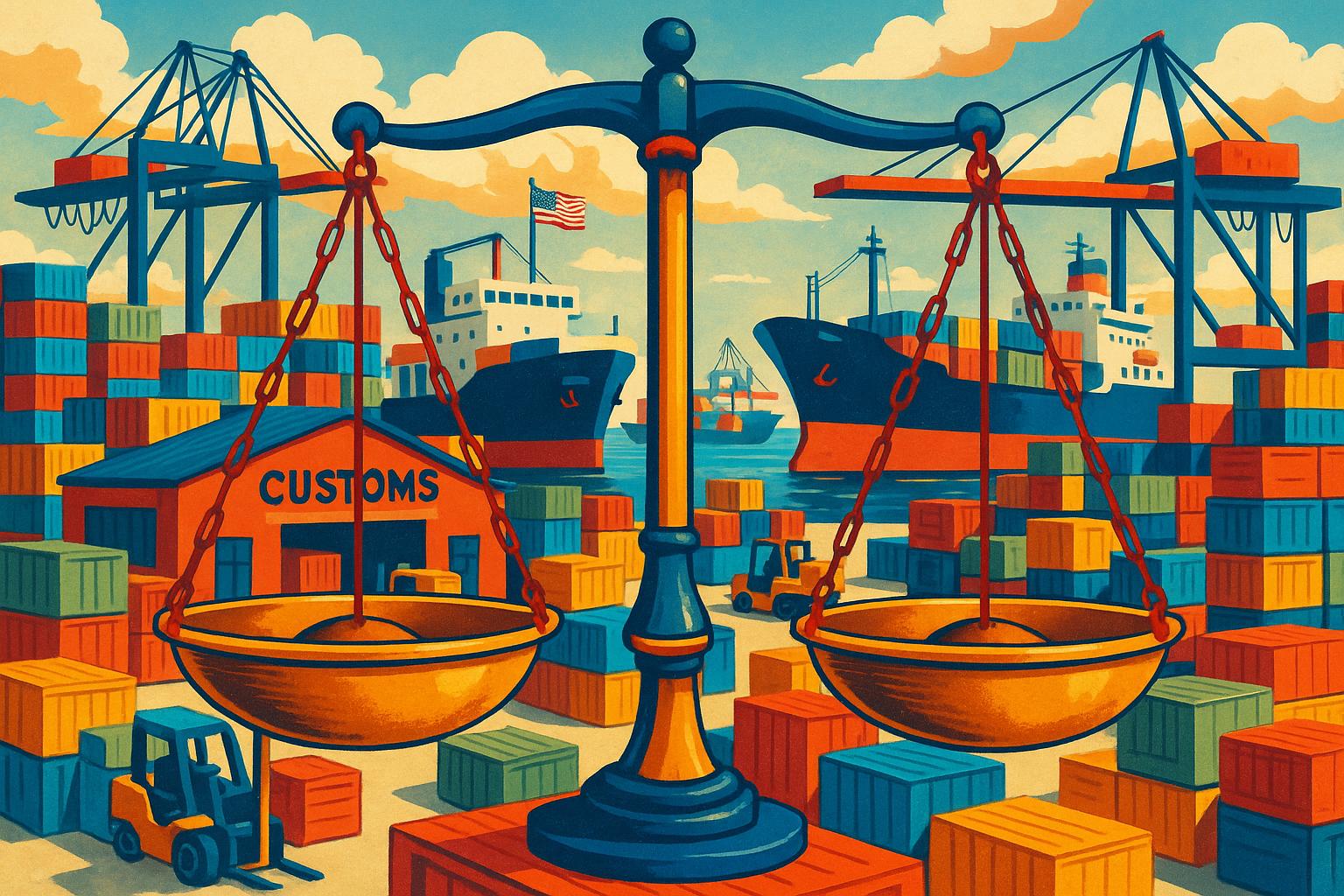
The Liberty Justice Center has filed a new lawsuit in the US Court of International Trade against President Trump’s recent tariffs, questioning the constitutional legality of executive trade powers amid broader legal battles.
The Liberty Justice Center has returned to court, filing a new challenge to President Donald Trump’s most recent set of tariffs on behalf of two small importers, the centre announced on Monday. The complaint, lodged at the US Court of International Trade, names spice importer Burlap & Barrel and toy maker Basic Fun as plaintiffs and seeks to block levies the administration imposed in late February.
The suit targets the 10% global tariffs announced after the Supreme Court on 20 February found that earlier duties enacted under the International Emergency Economic Powers Act (IEEPA) were unconstitutional. The tariffs took effect on 24 February and the White House has signalled an intent to raise them to 15%. According to the Liberty Justice Center, the administration’s use of Section 122 of the Trade Act of 1974 to justify the new duties is likewise impermissible.
“Section 122 authorizes temporary tariffs for certain economic conditions that do not currently exist; it is not a general license for the President to tax the American people for reasons Congress never intended,” the Liberty Justice Center’s Jeffrey Schwab , who argued the previous tariff case before the nine justices – said in a statement.
The Liberty Justice Center is the same public‑interest litigation group that in April 2025 brought V.O.S. Selections, Inc. v. Trump, a case challenging the so‑called Liberation Day tariffs imposed under IEEPA. According to the centre, that earlier suit represented five small businesses and argued that unilateral, across‑the‑board global tariffs required congressional authorisation. Industry and the centre said those tariffs disrupted supply chains and raised costs for US firms.
Last week the Court of International Trade ordered the government to refund at least $130 billion in previously collected duties, a development that added momentum to fresh litigation. Two dozen states also filed suit on 5 March contesting the administration’s latest tariff measures, broadening the legal challenge beyond private plaintiffs.
The new complaint emphasises separation‑of‑powers concerns, arguing that Section 122 does not confer a general taxing power on the executive. Burlap & Barrel, based in New York City, imports spices from small farmers worldwide; Basic Fun, headquartered in Boca Raton, Florida, manufactures toys such as Tonka Trucks in China.
The White House has defended the policy. “The President is using his authority granted by Congress to address fundamental international payments problems and to deal with our country’s large and serious balance‑of‑payments deficits,” White House spokesperson Kush Desai told The Post last week. The administration has said it will “vigorously defend” the tariffs in court.
The latest filing ensures the constitutionality of the administration’s trade actions will be tested again in the specialised trade court, even as parallel suits proceed. The outcome could determine whether future presidents can deploy similar tariff programmes without explicit congressional legislation.
Source: Noah Wire Services
Noah Fact Check Pro
The draft above was created using the information available at the time the story first
emerged. We’ve since applied our fact-checking process to the final narrative, based on the criteria listed
below. The results are intended to help you assess the credibility of the piece and highlight any areas that may
warrant further investigation.
Freshness check
Score:
7
Notes:
The article reports on a recent legal challenge filed by the Liberty Justice Center against new tariffs imposed by President Donald Trump. The Liberty Justice Center previously filed a similar lawsuit in April 2025, which was ruled upon in May 2025. The new lawsuit, filed in March 2026, appears to be a continuation of this legal battle. The article cites a recent court order from last week, indicating that the events are current. However, the narrative closely follows the earlier case, raising concerns about the originality of the content. The article's publication date is March 9, 2026, which is within the past seven days, so the freshness score remains relatively high.
Quotes check
Score:
6
Notes:
The article includes direct quotes from Jeffrey Schwab of the Liberty Justice Center and a White House spokesperson. A search for these quotes reveals that they have been used in previous reports, suggesting potential reuse of content. The exact dates of the earliest appearances of these quotes are not specified, but their repetition raises concerns about the originality of the reporting. Additionally, the article includes a quote from a previous case argued by Schwab, which may not be directly relevant to the current lawsuit.
Source reliability
Score:
5
Notes:
The article is published by the New York Post, a major news organisation. However, the New York Post has been criticised for sensationalism and bias in its reporting. The article cites the Liberty Justice Center, a public-interest litigation group, which has a vested interest in the outcome of the case. The White House spokesperson's comments are also included, but these may be biased in favour of the administration's position. The article does not provide independent verification of the claims made by these sources.
Plausibility check
Score:
7
Notes:
The article reports on a legal challenge to new tariffs imposed by President Trump, a topic that has been widely covered in the media. The Liberty Justice Center's involvement in the previous lawsuit is well-documented. The article's claims are plausible and align with known events. However, the reliance on quotes from parties with vested interests and the lack of independent verification raise concerns about the objectivity and accuracy of the reporting.
Overall assessment
Verdict (FAIL, OPEN, PASS): FAIL
Confidence (LOW, MEDIUM, HIGH): MEDIUM
Summary:
The article reports on a recent legal challenge to new tariffs imposed by President Trump, filed by the Liberty Justice Center on behalf of two small importers. While the events are current, the article closely follows previous reporting on the same case, raising concerns about originality. The reliance on quotes from parties with vested interests and the lack of independent verification further diminish the article's credibility. Given these factors, the overall assessment is a FAIL.